If you followed AI over the last few years, you probably noticed how quickly the conversation changed. First, it was all about chatbots and generative AI. Then came better image and video generation, AI coding assistants, and models that could handle longer and more complicated tasks.
But the next phase is becoming harder to describe with one simple word: chatbot.
The most important AI trends today are increasingly about what AI can do rather than only what it can generate. AI systems are becoming more capable of using tools, handling multiple types of information, working through complex problems, and operating inside real workflows. Gartner identifies agentic AI, multimodal capabilities, small reasoning models, and domain-specific models among the emerging technologies shaping the next phase of GenAI. Google’s 2026 announcements also put a strong emphasis on agents, multimodal models, coding, and real-world workflows.
So, if generative AI was the big story of the last phase, what comes next?
Here are 9 AI trends worth understanding, especially if you want a clearer picture of where the technology is heading.
1. Agentic AI: AI That Can Actually Take Action

One of the biggest AI trends is the move from systems that simply respond to systems that can work toward a goal.
A traditional chatbot generally waits for your prompt and gives you an answer. An AI agent can be designed to understand a goal, break it into steps, use tools, interact with software or information sources, and continue working through a task.
That difference is important, and it is one reason agentic AI is sitting near the center of current AI trends.
Imagine asking an AI to “research five companies and prepare a comparison.” A chatbot might give you information in one response. An agentic system could potentially search for information, organize it, compare the results, and produce an output through a sequence of actions.
This shift is already visible in current products. Google has introduced information agents in Search and agentic capabilities for longer-running tasks, while OpenAI describes agents as systems that can handle delegated, long-horizon work and orchestrate tool calls.
If you want to understand the chatbot-versus-agent difference more practically, check out 10 Things AI Agents Can Do That Chatbots Can’t.
The interesting part is that agents are not necessarily replacing the model underneath them. Instead, they are changing how the model is used: the model becomes part of a larger system that can plan, use tools, and act.
2. Multimodal AI: AI That Understands More Than Text
Another major AI trends shift is multimodality.
For a long time, many people experienced AI mainly through text: type something, get a response. But humans don’t communicate only through words. We use images, sound, video, documents, screens, gestures, and other forms of information.
Multimodal AI is designed to work across these different kinds of input and output.
For example, instead of describing a graph to an AI in text, you can give it the graph itself. Instead of explaining what is happening in a video frame by frame, a multimodal system can process the visual information directly. Newer models are also combining different input and output modalities in increasingly flexible ways.
Google’s 2026 announcements include Gemini Omni, described as a model capable of generating different output modalities from different input types, alongside continued work on multimodal capabilities.
This makes multimodality one of the AI trends that could change how people interact with AI. The interface doesn’t have to remain a text box.
3. Reasoning Models: AI That Spends More Effort Solving
Not every difficult question needs a longer answer. Sometimes it needs a better reasoning process.
Reasoning models are designed to spend more computational effort on complex tasks such as mathematics, coding, planning, and multi-step problem solving. Instead of treating every request like a quick question-and-answer exchange, these systems can work through more complicated problems before producing the final response.
This is closely connected to the rise of agents. An agent that has to plan several actions needs a model capable of handling those steps reliably.
Current industry analysis also points toward smaller reasoning models and reasoning systems being used as part of more cost-efficient AI architectures.
This is one of the AI trends worth watching because it changes the question from “Can AI answer this?” to “Can AI work through this problem?”
4. AI Coding Agents: From Writing Code to Working on Software
AI coding has moved beyond autocomplete.
Earlier coding assistants were mostly about helping developers write a function, explain an error, or complete a few lines of code. The newer direction is more agentic: AI systems can work across files, inspect a project, make changes, run tests, debug problems, and iterate.
That doesn’t mean developers can simply disappear from the process. Software still needs validation, security checks, architecture decisions, and human judgment. But the unit of assistance is getting larger.
Gartner describes the enterprise coding-agent market as moving from AI-assisted development toward agentic software development across parts of the software development lifecycle. OpenAI has also reported growing use of coding agents for longer and more complex tasks.
For students learning programming, this is an important shift and one of the practical AI trends to understand rather than simply watch from the sidelines.
Knowing how to write code still matters, but understanding how to review, test, debug, and direct AI-generated work matters too.
5. Smaller AI Models Are Becoming More Important
When people talk about AI progress, they often imagine bigger models requiring bigger data centers.
But another important direction is happening at the same time: smaller and more efficient models.
Why would a smaller model matter when larger models can be more capable?
Because real-world applications have constraints. Developers may care about speed, cost, memory, privacy, latency, or whether a model can run closer to the user. A specialized smaller model can sometimes be a better fit for a particular task than a huge general-purpose model.
IBM’s 2026 technology outlook highlights smaller, efficient reasoning models and the use of models tuned for specific domains. Google has also introduced Gemma 4 12B as a multimodal model designed to bring advanced capabilities to laptops with a reduced memory footprint.
This is one of the AI trends that is easy to miss if you only follow the race for the largest model.
The future may not be “one giant model does everything.” It may be a combination of models chosen for different jobs.

6. Domain-Specific AI Is Growing
AI doesn’t always need to know everything.
A system designed for medical research, financial analysis, software development, education, or cybersecurity may benefit from specialized knowledge and workflows.
That is why domain-specific AI is becoming another important direction. Instead of building one general system and expecting it to handle every possible situation equally well, developers can build models and agents around a particular field.
This also connects with agentic AI. An agent working in a specific domain needs more than general language ability; it may need specialized tools, data, rules, and workflows.
Gartner specifically identifies domain-specific models and domain-specific agents as part of the emerging GenAI landscape.
For users, this could mean AI products become less like one universal assistant and more like a collection of specialized digital coworkers. Among the broader AI trends, specialization is one of the easiest to connect with everyday products.
7. AI Search Is Becoming More Like an Assistant
Search used to have a fairly simple interaction:
You type a query → search engine finds pages → you open the links.
AI is changing that interaction.
Search systems are increasingly able to understand longer questions, summarize information, work with different kinds of inputs, and in some cases move toward taking actions rather than simply displaying results.
Google’s 2026 announcements include information agents in Search that can work in the background and help users take action. Google has also described longer-running Search experiences that can create persistent dashboards or trackers for specific tasks.
That doesn’t mean traditional search has suddenly disappeared. Instead, the search experience is expanding.
This is one of the AI trends that matters because the interface between humans and information is changing. We may increasingly tell a system what we want to accomplish instead of figuring out exactly which keywords to search.
8. Physical AI: When AI Moves Into the Real World
Most of the AI we’ve interacted with lives on a screen.
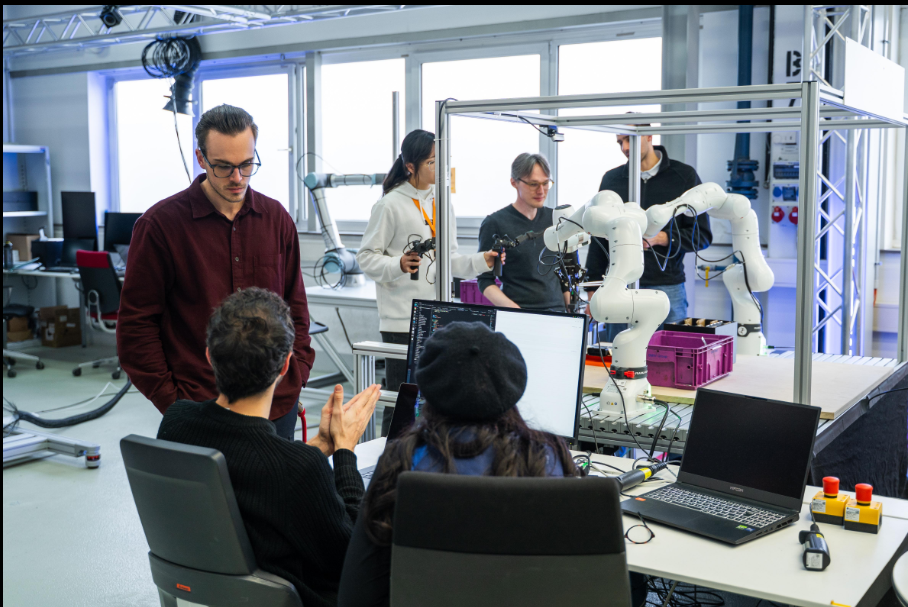
Physical AI takes a different approach: AI systems that can perceive and reason about the physical world and help control machines or robots.
Robotics is becoming closely connected with multimodal understanding, spatial reasoning, planning, and real-time decision-making. Google DeepMind’s 2026 robotics work, for example, describes models designed to provide robots with spatial reasoning, task planning, and multi-robot collaboration.
This creates a very different challenge from generating text or images.
A chatbot can produce an incorrect sentence and you can ask it to try again. A physical system operating a machine needs to deal with timing, movement, uncertainty, and safety in the real world.
That is why physical AI is one of the AI trends that could have consequences far beyond software.
9. AI Is Becoming a System, Not Just a Model
This might be the most important idea tying all the other AI trends together.
When people compare AI models, they often ask which one is smarter, faster, or better at a benchmark. But real AI applications are increasingly built from more than a model.
Think about the pieces involved:
Model + tools + APIs + data + memory + software + agents + human oversight
The model may provide the intelligence, but the surrounding system determines what it can actually accomplish.
This is why current AI development is increasingly focused on orchestration, tool use, agent infrastructure, and workflows. Google’s 2026 developer announcements describe a shift from prompts toward action, while OpenAI’s recent agent infrastructure focuses on long-running agents, tools, files, code execution, and coordination between agents.
In other words, the next wave of AI may not be defined only by a single “smartest model.” It may be defined by how effectively different components work together.
What Do These AI Trends Mean for Students?
You don’t need to learn every new AI tool that appears.
In fact, trying to chase every release can become exhausting very quickly.
A better approach is to understand the ideas underneath the tools.
Learn what an agent is. Understand how APIs allow systems to communicate. Learn the basics of machine learning and neural networks. Understand how models use context, tools, and data. Learn enough programming to build and test things yourself. And most importantly, learn how to question an AI output instead of automatically trusting it.
Understanding these AI trends is more useful than trying to memorize every AI product.
AI is also changing the way learning itself happens. You can use AI to explain a difficult concept, generate practice questions, debug your code, or challenge your understanding. But there is a difference between using AI as a learning partner and letting it do all the thinking for you.
I explored that question in Using AI to Learn — Is That Cheating?.
The goal isn’t to become someone who knows every AI product. It is to become someone who understands what these systems are capable of and how to use them thoughtfully.
Final Thoughts
The interesting thing about the AI trends of 2026 is that they are not moving in just one direction.
AI is becoming more agentic, more multimodal, more capable of reasoning, more useful for software development, and more connected to the physical world. At the same time, smaller and specialized models are making it possible to build AI for more specific environments and tasks.
And maybe that’s the bigger shift.
We are slowly moving from asking:
“What can AI generate?”
to asking:
“What can an AI system actually do?”
That is the part worth paying attention to.
Because the next chapter of AI may not be about one model replacing everything. It may be about models, tools, agents, software, and humans working together in ways we are only beginning to understand.
That is where the real AI trends become interesting—not just as buzzwords, but as technologies that are changing how we build, learn, search, and work.
Where Do You Think AI Is Heading?
After looking at all nine AI trends, one thing feels pretty clear: AI is moving beyond simply generating answers. It is becoming more capable of reasoning, taking action, working with different types of data, writing software, controlling physical machines, and becoming part of larger systems.
But here’s the interesting part: which of these changes do you think will actually affect the way we live, study, or work the most?
And which one do you think is getting more attention than it deserves?
I’d genuinely love to know your take. Drop your answer in the comments—especially if you disagree with something in this article. Sometimes the most interesting part of technology isn’t predicting what comes next, but discussing what we might be getting wrong.
Sources & Further Reading
- IBM — The Trends That Will Shape AI and Tech in 2026
- Gartner — Top Emerging Adoption Trends for Generative AI
- Google DeepMind — Gemini Robotics 2: Whole-Body Intelligence for Robots
- Google DeepMind — Gemini Robotics-ER 2
- IBM — What Is Agentic Coding?
- IBM — AI 2026 Roadmap: AI Becomes Software
- OpenAI — Introducing the Agents API
Pingback: Can AI Models Admit “I Don’t Know”? I Tested 5 AI Models