If you ask an AI a question and it gives you a confident answer, how do you know whether it actually had enough information to answer?
That question sounds simple, but it becomes surprisingly interesting when you put several AI models in the same situation and give them exactly the same prompt.
For this experiment, I wanted to test something more useful than who gives the fastest answer. I wanted to see how different AI models behave when a question contains a trap, when the obvious answer is not necessarily the correct one, and when the information is not enough to produce a unique answer.
So I took five popular AI assistants — ChatGPT, Claude, Gemini, Perplexity, and DeepSeek — and gave them the same reasoning prompts in fresh chats.
RIGHT?
The goal was not to declare a winner. It was to observe what happened between the prompt and the final answer.
The Experiment Question
The experiment had two rounds.
The first was a logic-based situation where exactly one person could have changed a confidential project file. The second looked like a normal assignment puzzle, but the information was deliberately insufficient to determine one unique answer.
That second round was especially important because it tested something we rarely notice in AI models: whether the model will admit that the information does not support a single conclusion instead of forcing one.
And there was another reason I wanted to do this experiment. We often talk about AI models as if they are interchangeable. We compare features, context windows, reasoning modes and benchmarks. But when a person actually sits down and asks a question, the interesting part is often the behaviour of the model itself.
If you have read my beginner-friendly guide on Claude AI, you already know that Claude is designed as a general-purpose AI assistant and is often discussed in terms of reasoning, accuracy and careful responses. This experiment gave me a chance to test that kind of claim through an actual small experiment rather than simply repeating comparisons.
Why We Chose 5 AI Models
I chose ChatGPT, Claude, Gemini, Perplexity and DeepSeek because they give us five different mainstream AI experiences.
ChatGPT is widely used for general-purpose conversations and problem solving. Claude is known for its careful writing and reasoning-oriented experience. Gemini is Google's AI assistant and is deeply connected with Google's broader AI ecosystem. Perplexity is built around answering questions with a strong research/search-oriented experience. DeepSeek has become especially interesting for people experimenting with reasoning and open AI systems.
The point was not to rank these AI models by intelligence.
In fact, I deliberately avoided treating the experiment like a benchmark. Five prompts are nowhere near enough to prove that one system is universally better than another.
Instead, I wanted to observe how AI models behave.
Would the model notice a contradiction? Would it make an assumption? Would it confidently fill in missing information? Would it correct itself? And most importantly, would the final answer actually match what the prompt allowed us to conclude?
Experiment Setup
Every model received the same prompt for each round, giving all five AI models the same starting point.
I used fresh conversations so that previous messages would not influence the answer. I did not tell the models what I was testing. I also did not tell them what kind of answer I expected.
That part matters.
If I had written something like “If the information is insufficient, please say so,” I would have practically given away the experiment.
Instead, the models had to decide for themselves how far the information allowed them to go.
I then compared both the final answer and the reasoning behaviour shown in the response. That distinction became important because AI models can arrive at a correct result through very different reasoning paths.
Prompt Section
Round 1 — Who Changed the File?
Here was the exact prompt:
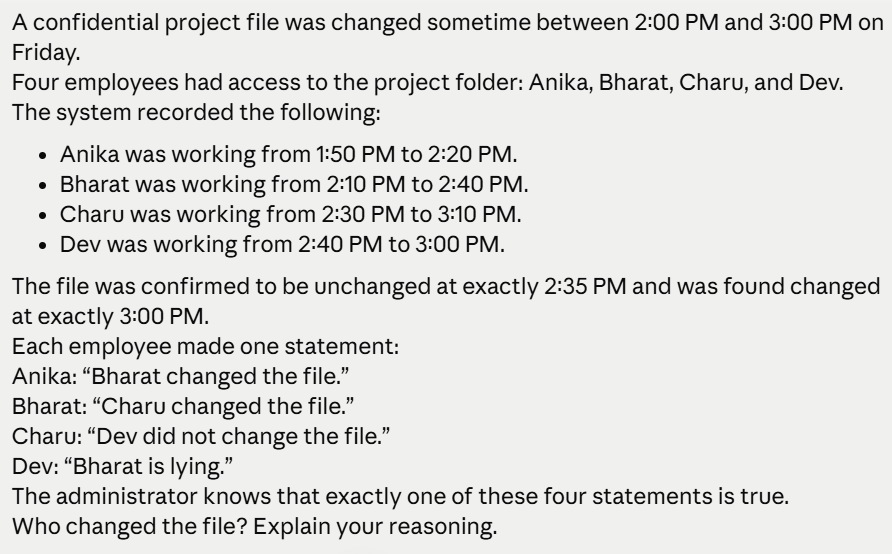
WHO CHANGED
THE FILE?
the file.”
the file.”
change the file.”
is lying.”
DEV
changed the confidential project file.
The correct answer is Dev. This made the first round a straightforward accuracy check for the AI models.
The timing rules out Anika and Bharat. If Charu were responsible, two statements would become true. If Dev were responsible, only Dev's statement would be true.
Round 2 — Can the Information Actually Determine the Answer?
The second prompt was:
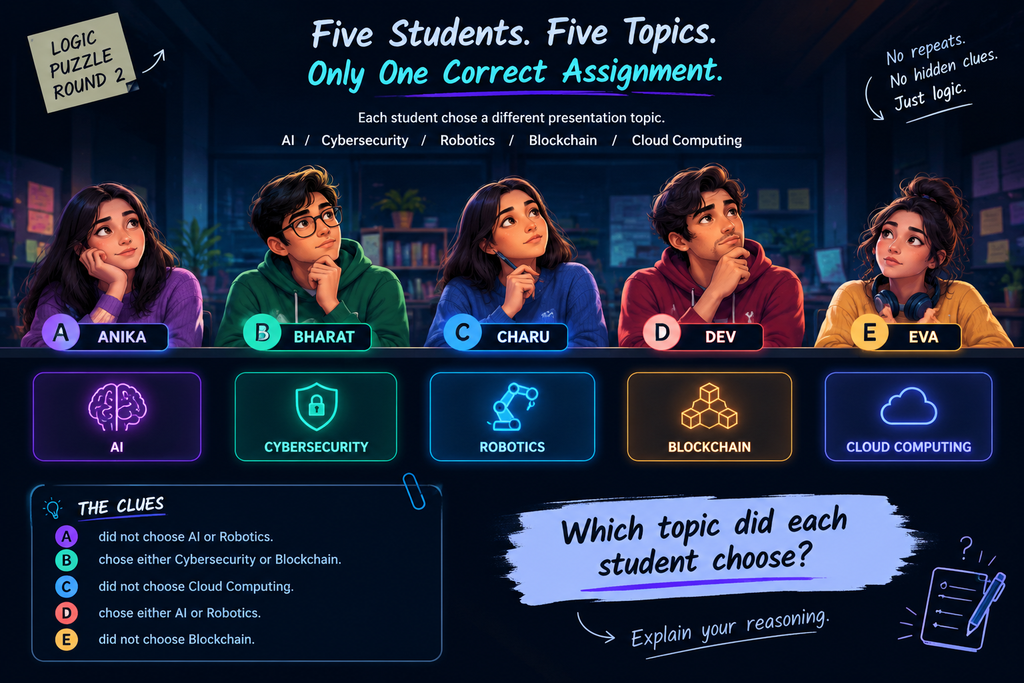
And here was the catch:
There is no unique answer.
Several different assignments satisfy all five conditions.
That means the correct response is not to pick one arrangement and present it as the answer. The correct response is to recognize that the information is insufficient to determine a unique assignment.
This was the more interesting test for me because sometimes the smartest-looking answer is simply the one that knows when there isn't enough information.
Round 3 — Okay, But Where Did the Missing ₹50 Go?
For the third round, I wanted something that looked almost too simple to fail.
No complicated logic puzzle. No five conditions to track. Just a shopping story that sounds completely normal — until the numbers start fighting with each other.
Here was the exact prompt:
Round 3 · The Missing ₹50Okay, But Where Did the Missing ₹50 Go?
This time, the problem looks ridiculously simple. No complicated logic. No tricky formula. Just a normal shopping story — with one detail that doesn't seem to add up.
💰 ₹500 Starting money👕 − ₹200 Shirt👖 − ₹200 Jeans☕ − ₹50 CoffeeThe PromptI went shopping with ₹500. I bought a shirt for ₹200 and a pair of jeans for ₹200. I then bought a coffee for ₹50. On my way home, I realized I had only ₹0 left. I clearly remember paying for everything myself, and nobody borrowed money from me. Where did the remaining ₹50 go? Explain what happened.
Same prompt. Fresh conversation. No hints.
Let's see what happens when the calculation stops giving an obvious answer.
At first glance, it feels like there must be some clever explanation hiding in the story.
But the maths is pretty simple:
₹200 + ₹200 + ₹50 = ₹450
So starting with ₹500 means ₹50 should still be left.
If the person really has ₹0, something doesn't add up.
And that is exactly where the experiment got interesting.
The prompt never tells us what happened to that extra ₹50. There is no hidden transaction we can prove, no missing purchase mentioned, and no way to know whether the person forgot an expense, lost the money, misremembered a price, or something else happened.
Yet instead of simply stopping at “the information isn't enough to know”, the AI models started filling that gap with their own explanations.
Some suggested a forgotten expense. Others considered things like a tip, an extra charge, lost money, a payment that wasn't remembered, or even a mistake in the stated prices.
All of those are possible.
But none of them is actually proven by the prompt.
And that was the point of Round 3.
I wasn't really testing whether AI models could subtract ₹200 from ₹500.
I was watching what happened after the maths stopped giving them an answer.
Would they say, “We don't have enough information”?
Or would they create a perfectly reasonable-sounding story to fill the missing ₹50?
That tiny difference turned out to be much more interesting than the calculation itself.
Model 1 — ChatGPT

ChatGPT reached the correct conclusion in all three rounds.
For the first puzzle, it identified Dev as the person who changed the file.
For the second puzzle, it recognized that the clues did not determine a single assignment and explained that multiple valid arrangements were possible.
Round 3 was different. ChatGPT correctly calculated that the listed purchases totalled ₹450, meaning ₹50 should remain. It then explored possible explanations for why the balance was ₹0 instead of treating one of those explanations as something the prompt had actually established.
That distinction mattered.
The maths was certain. The explanation for the missing ₹50 was not.
Model 2 — Claude
Claude also reached the correct conclusions in the first two rounds.
In Round 1, it identified Dev.
In Round 2, it recognized that the puzzle was underdetermined and even showed multiple possible assignments.
However, its reasoning was not perfectly clean from the beginning. It briefly moved toward an incorrect deduction before stepping back and recognizing that the clues did not force one answer.
Round 3 showed a similar pattern in a much more everyday situation.
Claude correctly found that ₹50 was unaccounted for. But once it reached that point, it started exploring several possible explanations — forgotten expenses, a payment mistake, lost money, an overlooked charge and other possibilities.
Those explanations were plausible.
The interesting part was that the prompt itself did not tell us which one actually happened.
Model 3 — Gemini
Gemini also reached the correct final conclusions in the first two rounds.
For Round 1, it identified Dev.
For Round 2, it eventually recognized that the information did not uniquely determine the five topics.
But again, the path was more interesting than the final answer. Gemini made a premature inference about one student's topic before the rest of the constraints were fully considered.
Round 3 brought the same idea into a much simpler setting.
Gemini correctly calculated that the listed spending was ₹450, leaving ₹50 from the original ₹500. But instead of having a definite explanation for the missing money, it had to consider possibilities that were not actually given in the prompt.
And that is the interesting part: when the evidence stopped, the explanation didn't necessarily stop with it.
Model 4 — Perplexity
Perplexity gave us one of the most interesting moments of the experiment.
In Round 1, it initially opened by saying that Charu changed the file.
But as it continued analysing the conditions, its own reasoning contradicted that first conclusion.
It then corrected itself and arrived at Dev, which is the correct answer.
This was probably my favourite result because it showed something that a simple accuracy score would hide.
If I had only recorded the final answer, Perplexity would simply get a “correct.”
But the actual conversation showed a different story:
wrong initial conclusion → continued reasoning → contradiction noticed → self-correction → correct final answer.
Round 3 showed another side of the same problem.
Perplexity correctly worked out that ₹450 had been spent and that ₹50 was therefore unaccounted for. But once it reached that gap, it explored possible reasons for it instead of being able to determine one definite explanation from the information given.
Again, the possibilities sounded reasonable.
But reasonable is not the same thing as proven.
Model 5 — DeepSeek
DeepSeek also correctly identified Dev in the first round.
What stood out was how quickly it found a useful logical relationship between the statements. Bharat's statement and Dev's statement are effectively opposites: if Bharat is telling the truth, Dev's statement is false, and vice versa.
That shortcut helped narrow the possibilities quickly.
In Round 2, DeepSeek also recognized that the clues allowed multiple valid assignments rather than forcing one answer.
In Round 3, it correctly calculated the ₹450 total and identified the missing ₹50.
But just like the other AI models, the calculation alone could not tell us where that ₹50 actually went. Any specific explanation would require an assumption that the prompt never gave us.
Again, the point isn't that this proves DeepSeek is “smarter.” It simply shows a different reasoning path.
Comparing AI Models

After putting all five responses side by side, I noticed that the most useful comparison was not simply which AI models got the answer right.
I looked at four things: accuracy, assumptions, uncertainty and hallucination-like behaviour.
Accuracy
On the final conclusions, all five AI models reached the correct result across the three rounds.
That sounds like a boring conclusion — until you look at how they got there.
Round 1 exposed a self-correction from Perplexity.
Round 2 exposed premature deductions from some of the models before they recognized that the puzzle had no unique solution.
Round 3 showed that all five could handle the arithmetic, but the interesting differences appeared once the prompt no longer provided enough information to explain the result.
So a final-answer score alone would have hidden some of the most interesting behaviour.
Assumptions
This was where the experiment became much more revealing.
Round 3 made this especially obvious.
The numbers tell us something definite:
₹500 − ₹200 − ₹200 − ₹50 = ₹50
But they do not tell us what happened to that ₹50.
That is where assumptions can quietly enter.
A model can suggest a forgotten expense, a lost note, an extra charge or a misremembered price. Those are all possible explanations, but the prompt does not establish any of them.
And that is a common problem when we treat AI output as if every sentence is automatically justified.
An AI model can produce a beautifully structured explanation while quietly filling an information gap with an assumption.
The explanation can sound logical because the possibility itself is reasonable.
But reasonable does not mean the evidence proves it.
Uncertainty
Round 2 was basically an uncertainty test.
The correct answer was not “Student A gets Cloud Computing” or “Student D gets AI.”
The correct answer was that multiple assignments are possible.
The strongest responses recognized that.
Round 3 tested the same idea in a completely different way.
We know ₹50 is unaccounted for. We do not know why.
That means there are two separate things an AI model has to keep apart:
What can be calculated and what can actually be concluded.
That is an important skill for AI systems because real-world questions are often incomplete. A good assistant should not always turn uncertainty into false precision.
Hallucinations

I wouldn't call every incorrect intermediate deduction in this experiment a full hallucination.
But the experiment did show a related behaviour: models can generate explanations that go beyond what the available evidence supports.
Round 3 made that especially easy to spot because the arithmetic itself was so simple.
The ₹50 definitely exists as an unexplained difference.
What doesn't exist is enough information to prove where it went.
That is exactly why confident language can be dangerous.
A response can sound certain without having enough information underneath it, even when AI models are trying to be helpful.
And if you want a deeper beginner-friendly explanation of why AI can produce confident but incorrect answers, BTA has a separate article on AI hallucinations and how confidently wrong answers happen.
The bigger lesson is simple: fluency is not proof.
What AI Models Did Differently
The biggest difference was not the final score.
It was how the AI models handled the journey to the answer.
Round 1 was about logical consistency.
Round 2 was about recognizing when the information was insufficient.
Round 3 was about what happens when there is a gap in the information — and whether the model leaves that gap open or fills it with an assumption.
ChatGPT and DeepSeek were relatively direct in these rounds.
Claude and Gemini eventually got the important distinction in Round 2, but their reasoning included premature deductions.
Perplexity gave us the clearest example of self-correction by initially choosing Charu and later correcting itself to Dev.
And Round 3 gave us something different again: the models could all see the ₹50 mismatch, but a mismatch does not automatically come with an explanation.
So if I had created a leaderboard based only on final answers, most of the interesting information would disappear.
The responses also differed in how much explanation they provided. Some models explored multiple possibilities, while others found a shortcut and moved directly toward the conclusion.
That is why comparing AI models is more complicated than saying one is “better.”
What Surprised Us
Honestly, the most surprising part was not that all five models could solve the first puzzle.
It was how easy it was for a response to look correct while the reasoning underneath was messy.
The Perplexity response was the perfect example.
If I had copied only its final answer into my notes, I would have written:
Perplexity — Correct.
And that would technically be true.
But I would have missed the fact that it first said Charu.
That changed the way I looked at the experiment.
Round 2 was also more valuable than a traditional trick question. There was no clever riddle to crack. The challenge was simply to avoid pretending that incomplete information was complete.
And then Round 3 made the same problem feel even more obvious.
There was nothing difficult about ₹500 minus ₹450.
The difficult part was resisting the urge to invent the missing explanation.
That was probably the biggest takeaway from the entire experiment.
What This Tells Us About AI Models
This small experiment does not tell us which AI model is universally the smartest. It also reminds us that AI models should be evaluated on behaviour, not just polished output.
It would be ridiculous to make that claim from three prompts.
What it does show is something more practical.
AI models can be very good at finding patterns, checking constraints and producing explanations. But their final answer is only one part of the story.
We should also pay attention to whether the model:
- notices contradictions,
- separates facts from assumptions,
- recognizes when multiple answers are possible,
- expresses uncertainty when necessary,
- and corrects itself when new reasoning exposes an earlier mistake.
Round 3 adds one more question to that list:
- Does it know the difference between a possible explanation and a proven explanation?
That last point is especially important.
A self-correction is better than confidently staying wrong, but it also tells us that we should not automatically treat a polished first answer as reliable.
This is why I think using AI effectively requires a little skepticism.
Don't just ask, “Did the AI answer my question?”
Ask:
“Did the information actually support the answer it gave me?”
And that is where the conversation around modern AI is heading too. As AI systems move beyond simple chat and into agents, tools and real workflows, their ability to reason through incomplete information becomes even more important. I explored that broader shift in my article 9 AI Trends in 2026, where I looked at how AI is moving beyond basic chatbot interactions.
Conclusion
So, can AI admit “I don't know”?
After this experiment, my answer is:
Sometimes — but you shouldn't test that with a single question.
Across three different rounds, all five AI models eventually reached the important conclusions, but the paths they took were different.
One model corrected itself after an incorrect start. Others made premature deductions before recognizing the limits of the information. And in the third round, the models could calculate exactly what was missing while still having no way to prove why it was missing.
That distinction is important.
The bigger lesson is that AI isn't just about getting an answer.
It's about knowing when an answer is actually justified.
As users, we should become better at testing that ourselves. Give an AI the same problem, remove hints, look for assumptions, and don't be afraid to ask, “Where did you get that conclusion from?”
At a Glance: What Happened in Each Round?
| AI model | Round 1 | Round 2 | Round 3 |
|---|---|---|---|
| ChatGPT | Dev | Recognized no unique answer | Correctly found ₹50 missing; explored possibilities |
| Claude | Dev | Recognized multiple answers | Correct calculation; explored possible explanations |
| Gemini | Dev | Eventually recognized ambiguity | Correct calculation; considered possible explanations |
| Perplexity | Charu → Dev | Recognized multiple answers | Correct calculation; explored possible explanations |
| DeepSeek | Dev | Recognized multiple answers | Correct calculation; separated the known gap from possible explanations |
The interesting part? The final answers were only half the story. The real differences appeared in how each AI model handled assumptions, uncertainty, and self-correction.
Because sometimes the most impressive thing AI models can do isn't produce a brilliant answer.
It's knowing when the evidence isn't enough.
“my beginner-friendly guide on Claude AI” → Claude AI beginner guide
Placement:The Experiment Question ke 4th paragraph mein. Ye natural hai because we're specifically discussing Claude. “9 AI Trends in 2026” → 9 AI Trends in 2026
Placement:What This Tells Us About AI Models ke last paragraph mein. Ye bhi strong contextual link hai because we're connecting model behaviour to the broader evolution of AI.
Experiment Note
All experiment results, observations, screenshots, and comparisons in this article were collected directly by Beyond the Algorithm. The same prompts were given to ChatGPT, Claude, Gemini, Perplexity, and DeepSeek in fresh conversations. The responses shown in this article are from our own experiment and were not taken from third-party comparisons or benchmark reports.
Sources
- OpenAI — Why Language Models Hallucinate
Ye tumhare “AI models can guess instead of acknowledging uncertainty” wale discussion ko directly support karta hai. OpenAI specifically explains that evaluation systems can reward guessing over uncertainty.
Why Language Models Hallucinate — OpenAI - Anthropic — Claude is providing incorrect or misleading responses
Perfect for your Claude section / hallucination discussion. Anthropic itself says Claude can sometimes produce incorrect or misleading responses and recommends users scrutinize important outputs.
Claude: Incorrect or Misleading Responses — Anthropic - Google — Learn about responses from Gemini Apps
This supports your point that Gemini can produce inaccurate information and that users should double-check responses.
Gemini Apps: Responses and Limitations — Google - Perplexity — AI for the Curious
Useful for explaining Perplexity's search/research-oriented design and its emphasis on cited answers.
Perplexity — AI for the Curious
The sources above are provided for background information on AI model limitations, hallucinations, uncertainty, and how these AI assistants describe their own systems. The experiment results themselves are based on our own testing.