You ask a chatbot, “Find me three good AI courses,” and it gives you a list. Pretty simple. Now imagine asking, “Find me three good AI courses under ₹10,000, compare their syllabus and reviews, check their current prices, and tell me which one is the best for an AI/ML student.” This time, you don’t just want an answer. You want the system to actually do some work for you.
And that is where AI agents become interesting.
We have become very comfortable with chatbots. We ask questions, get answers, ask follow-up questions, and move on. But AI agents are built around a slightly different idea: instead of only telling you what to do, they can be designed to work toward a goal by planning tasks, using tools, taking actions, checking the results, and deciding what to do next.
So, what exactly makes an AI agent different from a traditional chatbot? Let’s break it down.
So, What Exactly Is an AI Agent?
Before we get into the 10 things, there is one common confusion we should clear up. An AI agent is not simply a chatbot with a fancy name.
A traditional chatbot is mainly designed around conversation. You give it a prompt, and it generates a response. An AI agent can go a step further by reasoning about a goal, planning what needs to happen, using external tools, taking actions, observing the results, and continuing the task based on what it finds.
Think of it this way: a chatbot is mostly question → answer, while an AI agent can work more like goal → plan → action → result → adjustment → completion.
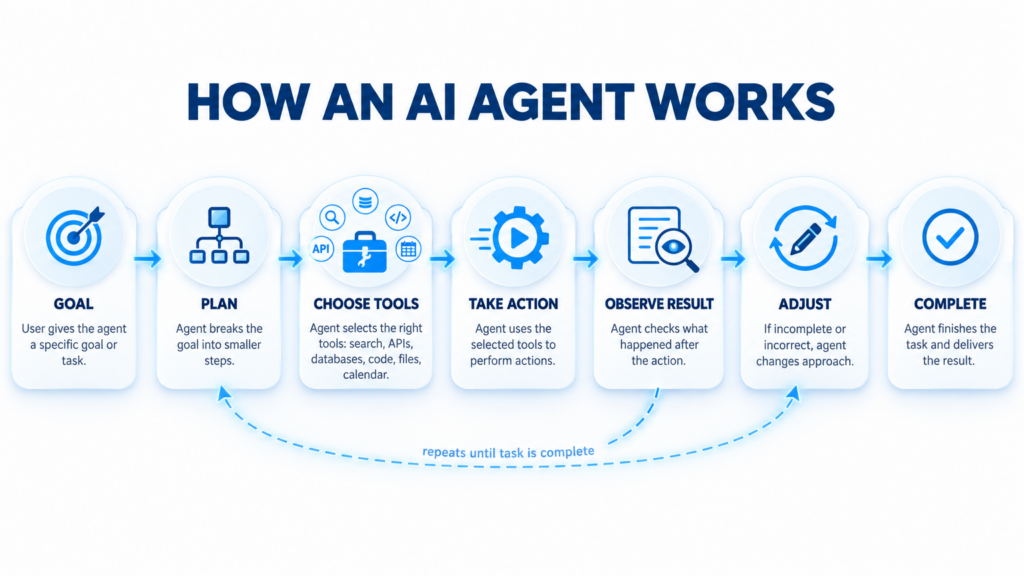
That extra loop is what makes AI agents so interesting.
1. AI Agents Can Actually Take Actions
This is probably the easiest way to understand the difference.
Suppose you ask a chatbot, “How can I schedule a meeting with my team?” It can explain the steps you need to follow. But an AI agent, if it has access to the right tools and permissions, could potentially check calendars, find a suitable time, create the meeting, and send invitations.
The important part here is the word potentially. An AI agent does not automatically have access to your calendar, email, or other applications. Developers have to give it those tools and the appropriate permissions.
That is what separates simply generating information from actually performing a task.
AI agents can be connected to APIs, databases, software, search tools, files, and other external systems. These tools give the agent capabilities that the language model itself may not have.
2. AI Agents Can Break a Big Goal Into Smaller Tasks
Humans do this without even thinking about it.
If someone tells you, “Plan my trip to Delhi,” you don’t see that as one giant task. Your brain automatically starts breaking it down. You think about transportation, hotels, dates, places to visit, budget, and timing.
An AI agent can be designed to do something similar. Instead of requiring you to provide every single instruction, it can take a larger objective and divide it into smaller tasks.
For example, if your goal is to find the best laptop for an AI/ML student under ₹80,000, the system might need to collect laptop specifications, compare RAM and GPU options, check current prices, filter unsuitable models, and finally create a shortlist.
The interesting part is that the agent can decide what needs to happen next based on the information it has already collected.
That is very different from simply asking an AI one question at a time.
3. AI Agents Can Choose Which Tools They Need
AI Agent: From Goal to Action
An AI agent connects reasoning with real-world tools.
Now things start getting more interesting.
Imagine an AI system has access to a web search tool, calculator, database, Python environment, APIs, and your files. You give it a task, but you don’t tell it exactly which tool to use.
The agent can determine what capability is needed for the current step.
If it needs current information, it can use a search tool. If it needs to perform a calculation, it can use a calculator. If it needs to analyse a CSV file, it can use a programming or data-analysis tool. If it needs information stored in a company database, it can query that database.
This is why saying “an LLM is an AI agent” isn’t quite accurate.
An LLM can act as the reasoning or language component, but an agentic system usually combines the model with things such as tools, state, instructions, memory, and an execution loop.
The model provides the intelligence, while the surrounding system gives it ways to actually interact with things.
4. AI Agents Can Keep Track of a Task
Imagine you give an AI a large research project. It has already collected several sources, removed irrelevant information, compared the useful ones, and started preparing a report.
If the system forgets what it has already done, you have a problem.
AI agents can be designed with memory and state so that they can keep track of important information, previous actions, intermediate results, and progress during a task.
This does not mean every AI agent has perfect human-like memory. It doesn’t.
Instead, developers can create mechanisms that allow the system to store and retrieve the information it needs while working through a particular task.
And this becomes especially important when the task isn’t finished in one single response.
5. AI Agents Can Check What Happened After an Action
This is one of my favourite parts of agentic systems because this is where the system starts behaving less like a simple question-answer machine.
Imagine an agent tries to use an API, but the API returns an error. A basic system might simply tell you that something went wrong.
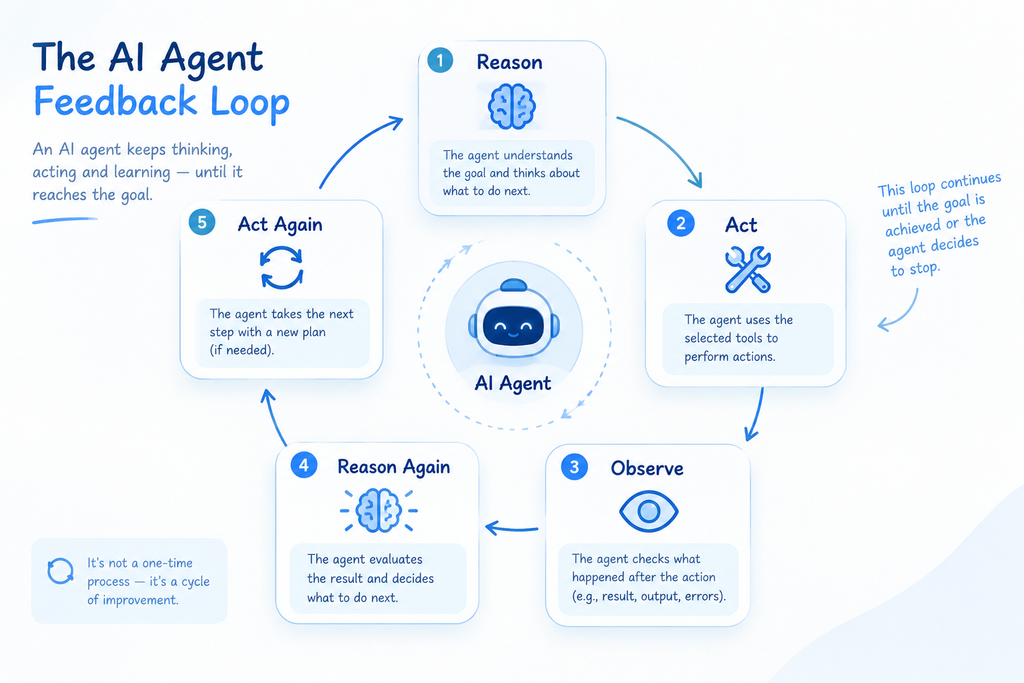
An agent can be designed around a loop where it takes an action, observes the result, and then decides what to do next.
For example, it could attempt a search, discover that the result isn’t useful, change its search strategy, find better information, and continue working.
The basic idea is:
Reason → Act → Observe → Reason again
This doesn’t mean the agent will always fix its own mistakes. It can still misunderstand information, choose the wrong action, or make a bad decision.
And this is important because AI agents are not magically immune to hallucinations.
If you’ve ever wondered why AI can sound extremely confident while giving you something completely wrong, I covered that in my article Why Does AI Hallucinate?.
Understanding hallucinations becomes even more important when an AI system is given the ability to take actions.
6. AI Agents Can Work With Information Outside the Model
A language model has knowledge learned during its training, but real-world information keeps changing.
Think about current prices, today’s weather, live inventory, company databases, private documents, or information on a website that was updated yesterday.
An AI agent can potentially use external tools to retrieve this information when it needs it instead of depending only on what the model already knows.
For example, if you ask an agent to compare the current prices of five laptops, it can be connected to a source that provides current information.
This is also where concepts like RAG, or Retrieval-Augmented Generation, become useful. Instead of expecting the model to know everything, relevant information can be retrieved and provided to it as context before generating an answer.
And if you’re new to the idea of AI models that you can actually experiment and build with, you can also check out my beginner-friendly article on Google’s Gemma.
The bigger idea is simple: the model doesn’t have to work alone.
7. AI Agents Can Handle Multi-Step Workflows
Here’s where a simple request can turn into an entire workflow.
Suppose you tell an agent, “Analyse this sales dataset and prepare a summary.”
That sounds like one sentence, but there could be a lot happening behind it. The system may need to open the file, understand the data, deal with missing values, perform calculations, identify patterns, create visualisations, and finally write a summary.
A workflow like this is very different from asking an AI, “What is data analysis?”
The first question requires the system to actually perform a series of operations.
That is why AI agents are particularly interesting for tasks where the next step depends on the result of the previous step.
Instead of simply generating an answer, the agent participates in the entire workflow.
8. AI Agents Can Interact With Software
This one sounds futuristic, but the idea is fairly straightforward.
An AI agent can potentially interact with software through APIs, functions, or computer-use interfaces.
Imagine telling an agent, “Take the information from this spreadsheet and enter it into our software.”
Depending on the tools available, the agent could read the spreadsheet, open the required application, enter information, observe what happens on the screen, and continue with the next step.
This moves AI from simply explaining computer work toward performing computer work.
And that distinction is huge.
Think about how many repetitive computer tasks people perform every day: moving information between applications, checking records, updating spreadsheets, filling forms, organising files, and so on.
If an AI agent can safely perform some of those workflows, it can become much more useful than a chatbot that only tells you which buttons to click.
9. AI Agents Can Work Together
Okay, now let’s make things a little more futuristic.
What if one agent doesn’t have to do everything?
Imagine one AI agent whose job is research, another that analyses the collected information, another that writes the report, and another that reviews the final result.
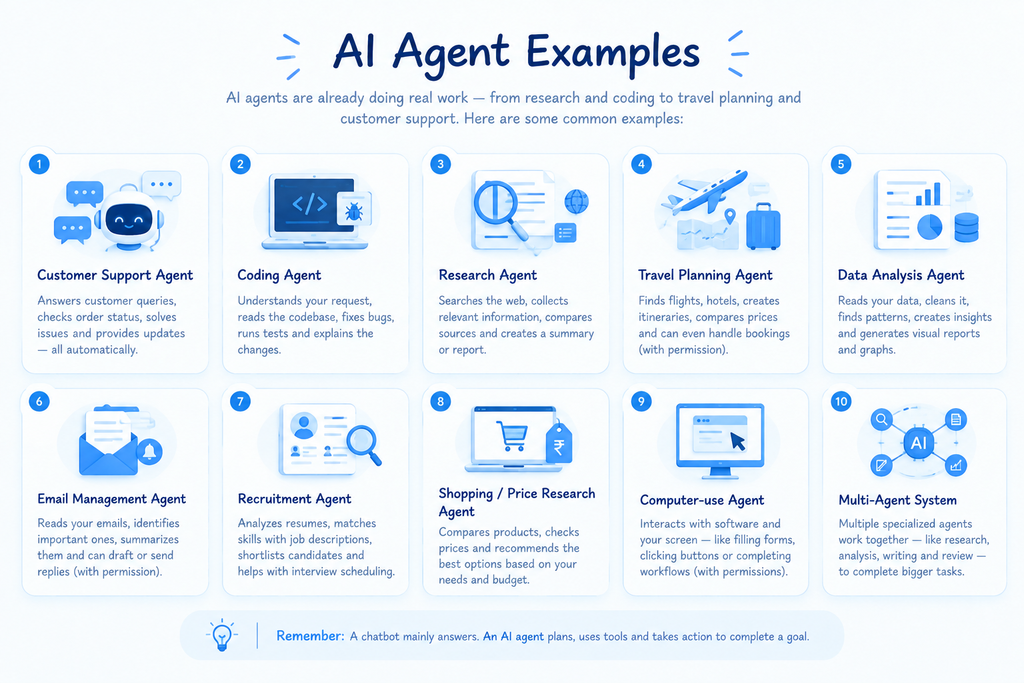
You could have a workflow where the Research Agent collects information, the Analysis Agent studies it, the Writing Agent creates the output, and the Review Agent checks it.
This is called a multi-agent system.
The idea is similar to having a team where different people have different responsibilities. Instead of asking one system to handle every part of a complicated task, specialised agents can potentially work together.
But more agents don’t automatically mean a better system. More agents also mean more complexity, more communication between components, potentially higher costs, and more places where something can go wrong.
Sometimes one well-designed agent is better than five unnecessarily complicated ones.
10. AI Agents Can Work Toward a Goal, Not Just Answer a Question
And this is probably the biggest difference of all.
A chatbot is usually built around a conversation. You ask something, it responds, you ask something else, and it responds again.
An agent is designed around a goal.
Suppose you say, “Find me the best flight option.”
The important part isn’t simply writing a nice paragraph about flights. The system needs to figure out what information it needs, which tools it should use, what options it should compare, what to do if something goes wrong, and when the task is actually finished.
That’s the shift from answering questions to pursuing goals.
And once you understand this, the whole idea of AI agents becomes much easier.
So… Are AI Agents Going to Replace Chatbots?
Not exactly.
And I wouldn’t make the mistake of saying, “Chatbots are old and AI agents are the future.” It’s not that simple.Chatbots are still extremely useful when you simply need an explanation, quick information, brainstorming, writing assistance, or a normal conversation. If you ask, “Explain recursion to me,” you don’t need an autonomous agent running through five different tools just to give you an explanation. That would be like using a bulldozer to plant a flower. The real question is whether the task requires the AI to take actions, use tools, make decisions, or work through multiple steps. If it does, an agentic approach can make much more sense.
The Simple Difference
If I had to explain the whole article in one simple comparison, it would be this:
A traditional chatbot usually follows the pattern You → Prompt → AI → Answer.
An AI agent can work more like You → Goal → Understand → Plan → Choose Tools → Take Action → Observe → Adjust → Repeat → Complete Goal. That’s the real shift. It isn’t simply about making AI sound smarter. It’s about giving an AI system the ability to do more than generate a response.
But There’s a Catch…
More autonomy also means more responsibility. If an AI only gives you an incorrect answer, the damage might be limited to bad information. But if an AI can actually take actions, a mistake can have consequences in the real world. Imagine an agent sending the wrong email, changing the wrong database record, purchasing something unnecessarily, deleting important information, or making a decision based on incorrect data. Suddenly, accuracy isn’t the only concern. You also need permissions, verification, monitoring, and sometimes human approval before an action is completed. This is one of the reasons building useful AI agents is much harder than simply building an AI that can talk. The more capable the system becomes, the more carefully we have to decide what it is allowed to do.
The Bigger Picture
We’ve spent the last few years getting excited about AI that can generate things: text, images, code, audio, and much more. But the next interesting question is: What happens when AI can use those abilities to actually do things? That’s where AI agents enter the picture. An LLM can provide a powerful model. Tools give it capabilities. Memory can give it context. Planning gives it direction. And an action-feedback loop allows it to keep working toward a goal. Put those pieces together, and you get something that starts looking less like a chatbot and more like a digital worker. We’re still figuring out how reliable, safe, and useful these systems can become. But one thing is already clear: the future of AI isn’t only about getting better answers. It’s also about what happens after the answer. And honestly, that’s where things start getting interesting.
Final Thought
The next time you open a chatbot, don’t just ask:
“What can you tell me?”
Try asking a different question:
“What could you actually do?”
Because that small change in perspective is the difference between AI that talks and AI that acts.
Pingback: 9 AI Trends in 2026 That Go Beyond Generative AI - Beyond The Algorithm
The comparison between a chatbot listing AI courses and an agent checking prices, syllabi, and reviews clearly shows the difference between answering and taking action. The ₹10,000 budget example is especially practical for students making real decisions.
Absolutely The real value lies in making decisions easier, not just collecting information. For students especially, comparing options within a fixed budget can save both time and effort. That’s where AI agents can make a practical difference!
The course-search example clearly captures the difference between simply generating a list and actually comparing prices, syllabi, and reviews to make a recommendation. That shift from answering questions to completing multi-step tasks is what makes AI agents genuinely useful.
Exactly! That’s what makes AI agents so interesting. It’s not just about giving answers, but about connecting the steps, evaluating options, and helping users reach a meaningful decision. That’s where the real potential lies!
Pingback: Website Optimization: 9 Reasons Your Website Isn't Growing Your Business - Beyond The Algorithm