
Introduction: So, What Exactly Is AI?
Artificial Intelligence is everywhere today. From the recommendations you receive on YouTube to chatbots that answer your questions, AI has quietly become a part of our everyday lives. And with tools like ChatGPT and other generative AI systems becoming increasingly popular, understanding AI is no longer just for computer science students.
But here is something worth asking: do you actually understand what happens behind these tools?
You might know that AI can generate text, recognize faces, solve problems, and make predictions. But how does it do these things? How did AI evolve into what we see today? And are all AI systems built in the same way?
That is exactly what we are going to explore in this guide to Artificial Intelligence Basics.
We will start with a simple definition, explore the history and types of AI, understand different approaches to building intelligent systems, and finish with real-world applications and limitations. No complicated mathematics or advanced programming knowledge is required.
Think of this as building the foundation you need before diving deeper into machine learning, deep learning, or generative AI.
From Data to Intelligence
Patterns. Connections. Possibilities.
1. What Is Artificial Intelligence? Definition and Goals
Artificial Intelligence (AI) is a field of computer science focused on developing systems that can perform tasks commonly associated with human intelligence.
These tasks include learning from data, recognizing patterns, understanding language, reasoning, solving problems, and making decisions.
For example, when your phone recognizes your face, an AI system analyzes visual information to determine whether it matches the enrolled face. When a music application recommends a song, its recommendation system uses information about listening behavior and other relevant signals to suggest something you might enjoy.
Both are examples of AI, but they solve very different problems.
Understanding these examples is the first step toward learning Artificial Intelligence Basics.
What are the main goals of AI?
AI is developed to achieve several important goals.
1. Automating tasks: AI can handle repetitive or complex tasks, reducing the need for humans to perform every step manually.
2. Improving decision-making: AI systems can analyze large amounts of information and identify patterns that help people make informed decisions.
3. Solving complex problems: Some problems involve so much data or computation that traditional manual methods become impractical. AI can help analyze such problems more efficiently.
4. Learning from experience: Machine learning allows systems to improve their performance on a task by learning patterns from data rather than relying entirely on manually written rules.
5. Understanding human communication: Natural language processing enables computers to work with human language, supporting applications such as translation, text analysis, and conversational assistants.
The important thing to remember is that AI does not necessarily think or understand things the way humans do. A system can perform an intelligent-looking task without possessing human consciousness or emotions.
That distinction becomes especially important when we explore modern generative AI.
2. A Brief History of Artificial Intelligence
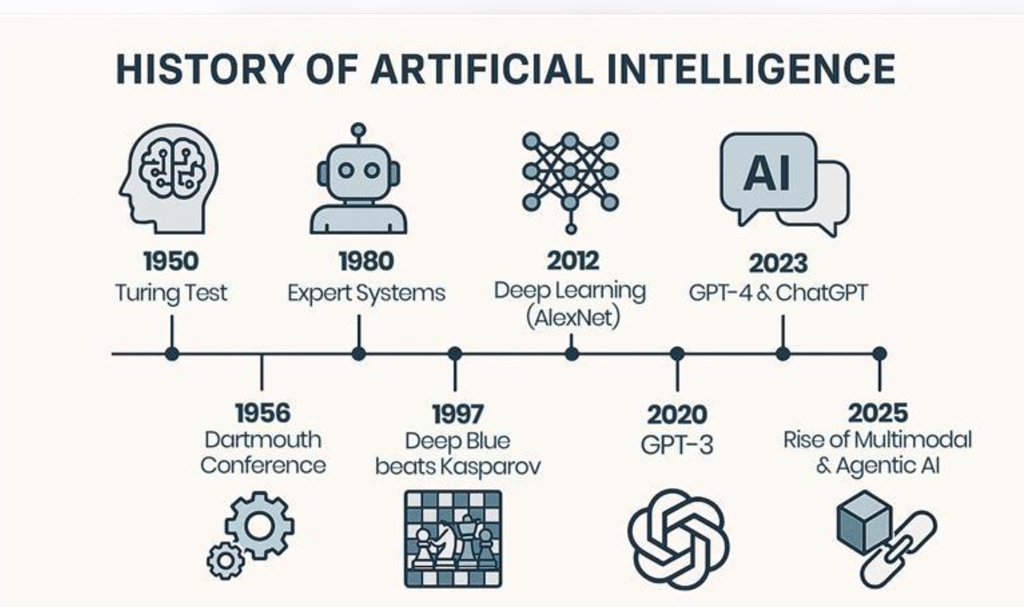
AI did not suddenly appear when ChatGPT became popular. Its development spans decades of research, experiments, setbacks, and breakthroughs.
Here is a quick timeline to help you understand how we reached the current stage of AI development.
1950: Alan Turing and the Turing Test
In 1950, mathematician Alan Turing published a paper exploring whether machines could demonstrate behavior that appears intelligent. He proposed what later became known as the Turing Test.
In a simplified version, a human judge communicates with a machine and a human without seeing them. If the judge cannot reliably distinguish the machine from the human through conversation, the machine may be considered successful at this test.
The test was an influential early contribution to discussions about machine intelligence, although passing it does not prove that a machine genuinely understands or thinks like a human.
1956: The Birth of Artificial Intelligence as a Field
The Dartmouth Summer Research Project on Artificial Intelligence took place in 1956. The proposal for this project used the term artificial intelligence, which became the name of the emerging research field.
Researchers explored whether aspects of learning and intelligence could be described precisely enough for machines to simulate them.
This event is widely regarded as a foundational moment in AI history.
1960s–1970s: Early Programs and AI Winter
Early AI researchers developed programs capable of solving particular problems, manipulating symbols, and following logical steps.
However, early systems struggled with the complexity of real-world situations. Progress was slower than many expectations, and limitations in computing power and available data restricted what researchers could achieve.
Periods of reduced funding and interest followed. These setbacks are commonly associated with the term AI winter.
1980s: The Rise of Expert Systems
Expert systems became popular because they could use predefined rules and domain knowledge to solve specific problems.
For example, a medical expert system could apply rules created by specialists to help evaluate possible diagnoses.
These systems demonstrated the practical value of AI, but maintaining large collections of rules could become difficult, especially when situations were uncertain or the rules needed frequent updates.
1990s–2000s: Machine Learning Gains Momentum
Researchers increasingly explored approaches that allowed computers to learn patterns from data.
One famous milestone occurred in 1997, when IBM’s Deep Blue defeated world chess champion Garry Kasparov in a match.
This was a significant achievement in computer chess, although Deep Blue relied heavily on specialized search and evaluation techniques rather than learning chess in the same way a modern machine learning system might.
2012 Onward: The Deep Learning Boom
Improvements in computing power, access to large datasets, and advances in neural network techniques helped deep learning achieve major breakthroughs.
In 2012, AlexNet demonstrated impressive performance in the ImageNet image-recognition competition, helping accelerate interest in deep neural networks.
Deep learning subsequently advanced areas such as speech recognition, computer vision, and language processing.
2017 Onward: Transformers and Generative AI
In 2017, researchers introduced the Transformer architecture in the paper Attention Is All You Need.
Transformers became a foundation for many modern language models because they can learn relationships between elements in sequences, such as words in a sentence.
This development contributed to the rapid progress of large language models and modern generative AI systems.
If you want to understand the modern side of this evolution, explore our related article on Generative AI, which discusses broader developments shaping the AI landscape.
Looking at this timeline is useful because Artificial Intelligence Basics becomes easier to understand when you recognize that today’s systems are built on decades of research rather than appearing overnight.
3. Types of AI Based on Capabilities
When people discuss AI, they sometimes imagine machines that can perform every intellectual task a human can perform. In reality, most AI systems are designed for specific tasks.
AI is often divided into three categories based on its theoretical capabilities.
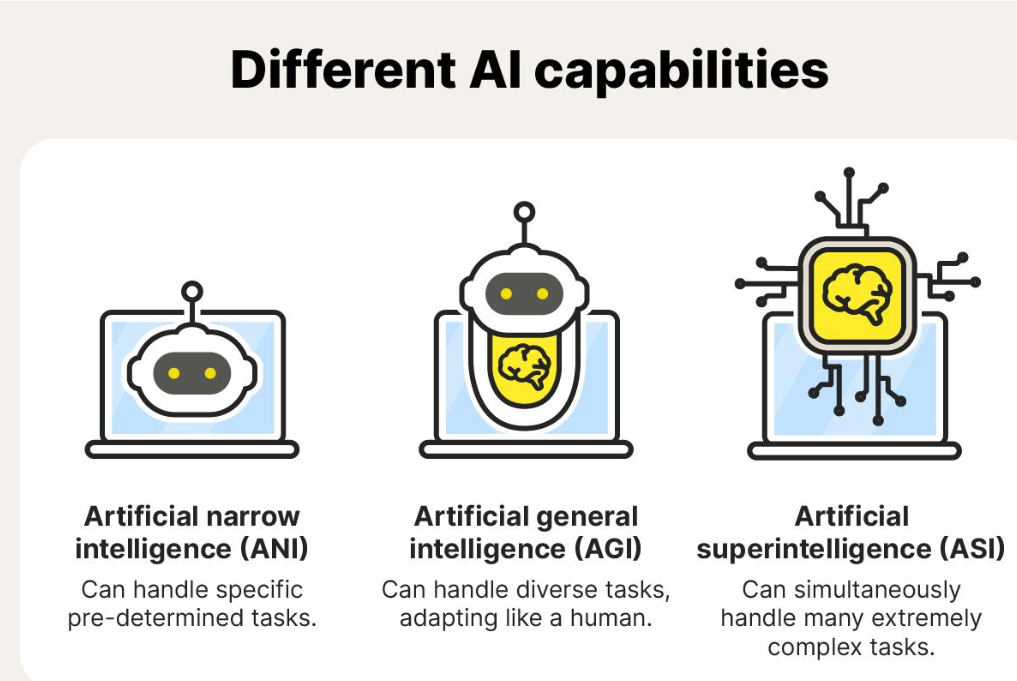
1. Artificial Narrow Intelligence (ANI)
Artificial Narrow Intelligence, also called narrow AI, is designed to perform particular tasks or a limited range of related tasks.
Examples include:
- Voice assistants that respond to spoken commands.
- Recommendation systems that suggest videos or products.
- Face-recognition systems that identify enrolled users.
- AI tools that translate text between languages.
- Models that detect suspicious financial transactions.
These systems can be highly capable within their intended domains without possessing general human-like intelligence.
For instance, a model trained to recognize objects in photographs does not automatically know how to write software, diagnose a disease, or manage a business.
Most AI systems currently in practical use fall into the narrow AI category.
2. Artificial General Intelligence (AGI)
Artificial General Intelligence refers to a hypothetical or not-yet-established level of AI that could learn, reason, and perform a broad range of intellectual tasks with generality comparable to human intelligence.
The idea is that such a system would not be limited to one narrowly defined task. It could potentially transfer knowledge across different domains and adapt to unfamiliar problems.
AGI remains a subject of active research and debate. There is no universally accepted test for establishing that a system has achieved it.
3. Artificial Superintelligence (ASI)
Artificial Superintelligence describes a hypothetical AI that would surpass human intellectual capabilities across a broad range of domains.
It is a concept discussed in AI research, philosophy, and debates about future technology. It should not be confused with a currently established category of existing AI systems.
Understanding these distinctions is an important part of Artificial Intelligence Basics because impressive performance on one task does not automatically mean a system possesses general intelligence.
4. Rule-Based AI vs Learning-Based AI
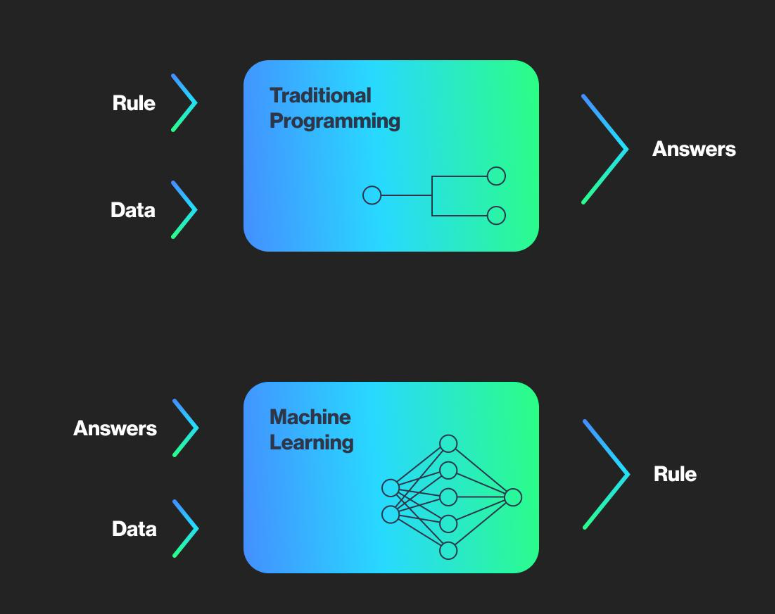
Not every AI system learns from data. Some follow rules written by humans, while others learn patterns from examples.
This difference helps explain two important approaches to building intelligent systems.
Rule-Based AI
Rule-based systems make decisions using explicitly defined rules.
Imagine a simple temperature-monitoring system:
temperature = 42

if temperature > 40:
    print("Warning: High temperature!")
else:
    print("Temperature is normal.")
Here, the programmer specifies the condition. If the temperature exceeds 40, the system displays a warning.
The system does not learn what a high temperature means from examples. It simply follows the instruction provided.
Advantages:
- The rules are easy to inspect.
- The behavior is predictable when the rules are clear.
- It works well for well-defined problems.
Limitations:
- Someone must define and maintain the rules.
- New or unexpected situations may not be handled well.
- Large collections of rules can become difficult to manage.
Rule-based systems are useful when the decision logic is clear and can be expressed explicitly.
Learning-Based AI
Learning-based systems use data to discover patterns and build models that can make predictions or decisions.
For example, a machine learning model could be trained using thousands of labeled email examples to distinguish spam from legitimate messages.
Instead of writing a separate rule for every possible spam message, developers provide data and select a learning method. The model adjusts its internal parameters during training to improve performance on the task.
Advantages:
- It can identify patterns that are difficult to describe manually.
- It can generalize to new examples when trained appropriately.
- It can be useful for complex tasks involving images, language, and large datasets.
Limitations:
- It depends on the quality and suitability of its training data.
- It can learn unwanted biases from the data.
- Its predictions can be incorrect.
- Training and evaluation require careful work.
A useful way to remember the difference is this: rule-based AI follows rules people explicitly provide, while learning-based AI builds a model from examples.
This is one of the most practical distinctions to understand when learning Artificial Intelligence Basics.
5. Symbolic AI vs Statistical AI
Rule-based AI and learning-based AI explain how systems use rules or data. Symbolic AI and statistical AI offer another way to understand different approaches to representing knowledge and solving problems.
These categories overlap with the previous section, but they focus on different aspects of AI.
Symbolic AI
Symbolic AI represents knowledge using symbols, logical expressions, facts, and rules.
For example, a simple knowledge system might contain the following facts:
- All humans are mortal.
- Ravi is a human.
Using logical reasoning, the system can infer that Ravi is mortal.
This approach is useful when knowledge and reasoning can be expressed explicitly.
Advantages:
- Rules and reasoning steps can often be inspected.
- It can produce understandable explanations.
- It works well for structured knowledge and clearly defined logic.
Limitations:
- Real-world knowledge can be difficult to represent completely.
- Handwritten rules may not handle ambiguity well.
- Maintaining a large knowledge base can be challenging.
Expert systems are a well-known example of symbolic AI.
Statistical AI
Statistical AI relies on mathematical models, probability, and patterns learned from data.
For example, a machine learning model might analyze historical transactions to estimate whether a new transaction is suspicious.
Rather than relying exclusively on a person writing every decision rule, the model learns relationships from examples.
Advantages:
- It can discover complex patterns in large datasets.
- It can handle uncertain or noisy information.
- It supports tasks such as image recognition, speech processing, and language modeling.
Limitations:
- Its predictions depend on the data and assumptions used.
- Some models are difficult to interpret.
- Statistical relationships do not automatically establish cause and effect.
Neural networks and many machine learning models are examples of statistical AI approaches.
What Is Neuro-Symbolic AI?
Neuro-symbolic AI explores ways to combine neural networks with symbolic reasoning.
A neural network might recognize patterns in an image, while a symbolic component applies explicit rules or logical constraints to reason about the result.
The goal is to combine the pattern-recognition strengths of learning-based systems with the structured reasoning and interpretability that symbolic methods can offer.
However, combining the two approaches does not automatically solve every problem. Their effectiveness depends on how the system is designed and evaluated.
For anyone studying Artificial Intelligence Basics, the main takeaway is that AI is not a single technique. Different approaches have different strengths, and some systems combine them.
6. Applications and Limitations of AI
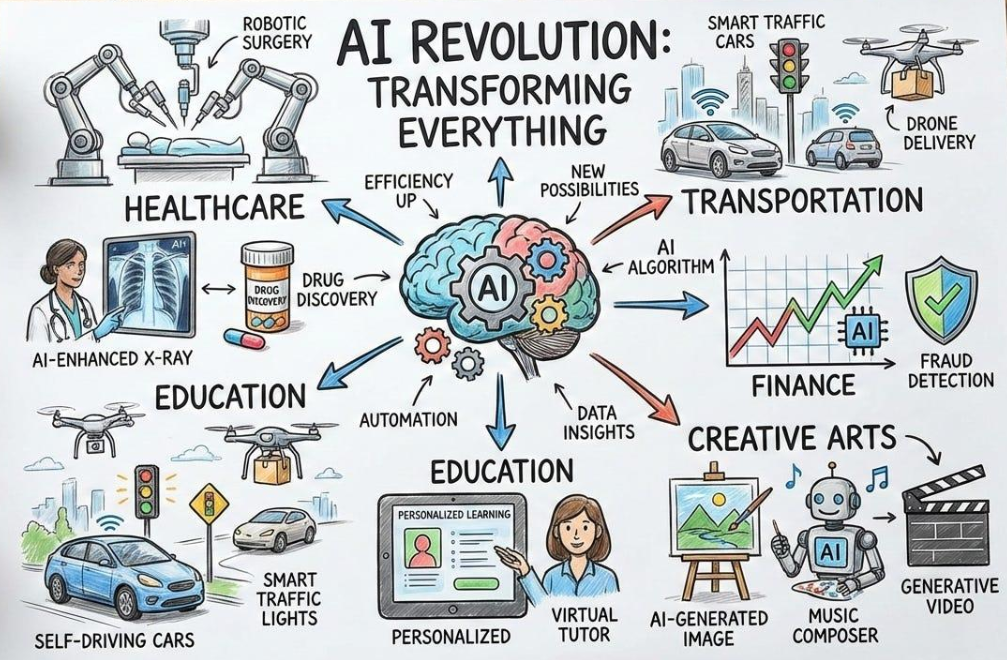
AI is useful in many industries, but understanding its applications without understanding its limitations gives us only half the picture.
Let’s examine both sides.
Where Is AI Used?
Healthcare: AI systems can assist with medical-image analysis, help identify patterns in clinical data, and support certain diagnostic workflows. Their outputs still require appropriate clinical oversight.
Finance: Machine learning models can help detect unusual transactions, estimate financial risks, and identify patterns that may indicate fraud.
Education: AI-powered tools can help personalize practice questions, explain difficult concepts, and provide feedback based on a learner’s progress.
Transportation: AI supports route optimization, driver-assistance features, traffic prediction, and research into autonomous vehicles.
Everyday applications: Translation tools, voice assistants, search engines, spam filters, and recommendation systems use AI techniques to provide useful services.
Software development: AI tools can suggest code, explain programming errors, summarize documentation, and assist developers with repetitive tasks. Their output still needs to be reviewed and tested.
These examples show why Artificial Intelligence Basics matters beyond the classroom. Understanding the technology helps us recognize both its potential and the situations where caution is necessary.
What Are the Limitations of AI?
Despite its progress, AI has several important limitations.
1. Dependence on data
Many AI systems depend on suitable training data. Incomplete, outdated, inaccurate, or unrepresentative data can reduce their performance.
2. Bias
If training data reflects existing social or historical biases, a model may reproduce or even amplify those patterns. Developers must evaluate systems for unfair outcomes rather than assuming that computers are automatically objective.
3. Limited common-sense reasoning
AI systems can produce impressive answers while struggling with unfamiliar situations, hidden assumptions, or tasks requiring reliable understanding of the physical and social world.
4. Hallucinations
Generative AI systems can produce information that sounds convincing but is false or unsupported. A fluent explanation is not proof of accuracy.
For a deeper explanation, read Why Does AI Hallucinate?.
5. Explainability
Some complex models, especially large neural networks, do not provide straightforward explanations for every prediction. This can make auditing and troubleshooting more difficult.
6. Privacy and security
AI systems may process sensitive information. Poor data handling, insecure integrations, or inappropriate use can expose people to privacy and security risks.
7. Cost and energy consumption
Training and operating large AI models can require substantial computing resources, electricity, hardware, and infrastructure. The actual cost depends on the system and how it is used.
8. Employment and ethical concerns
Automation can change the tasks people perform at work and may reduce demand for certain activities while creating demand for others. Responsible adoption requires attention to worker transitions, accountability, accessibility, and the broader effects on society.
Learning Artificial Intelligence Basics means understanding that AI is a tool with real capabilities, not a magical solution to every problem.
Frequently Asked Questions
Is AI the same as machine learning?
No. Artificial Intelligence is the broader field concerned with building systems that perform intelligent tasks. Machine learning is a subfield of AI that develops models capable of learning patterns from data.
You can explore 9 Machine Learning Concepts Every AI Beginner Should Know to understand this relationship in more detail.
Is generative AI a type of AI?
Yes. Generative AI is a category of AI that creates new content, such as text, images, audio, video, or code. Many modern generative AI systems use deep learning and neural network architectures such as Transformers.
Does every AI system learn from data?
No. Rule-based and many symbolic systems operate using explicitly defined rules and knowledge. Learning-based systems, on the other hand, use data to develop models or improve performance.
Is AGI already available?
There is no universally accepted determination that artificial general intelligence has been achieved. Existing AI systems can perform many impressive tasks, but their capabilities and limitations vary, and broad human-level general intelligence remains a contested research question.
Can AI make mistakes?
Absolutely. AI can make incorrect predictions, reproduce bias, misunderstand context, or generate false information. Important outputs should be checked against reliable evidence, especially in high-stakes situations.
Final Thoughts: Build Your AI Foundation First
AI can seem overwhelming when every week brings a new model, tool, or technical term. But you do not need to understand everything at once.
Start with the fundamentals. Understand what AI is, how it evolved, why different types exist, and how rule-based systems differ from models that learn from data. Then explore machine learning, deep learning, and generative AI one step at a time.
That is the real value of learning Artificial Intelligence Basics: instead of memorizing names and definitions, you begin to understand how different ideas fit together.
And remember, understanding AI does not mean blindly trusting it. The more you learn about how these systems work, the better you become at questioning their answers, evaluating their limitations, and using them responsibly.
At Beyond the Algorithm, the goal is not just to learn what technology can do. It is to understand how it works, why it matters, and where we should draw the line.
Keep learning, keep questioning, and keep looking beyond the algorithm.
Pingback: Generative AI Explained: What It Is and How It Works