
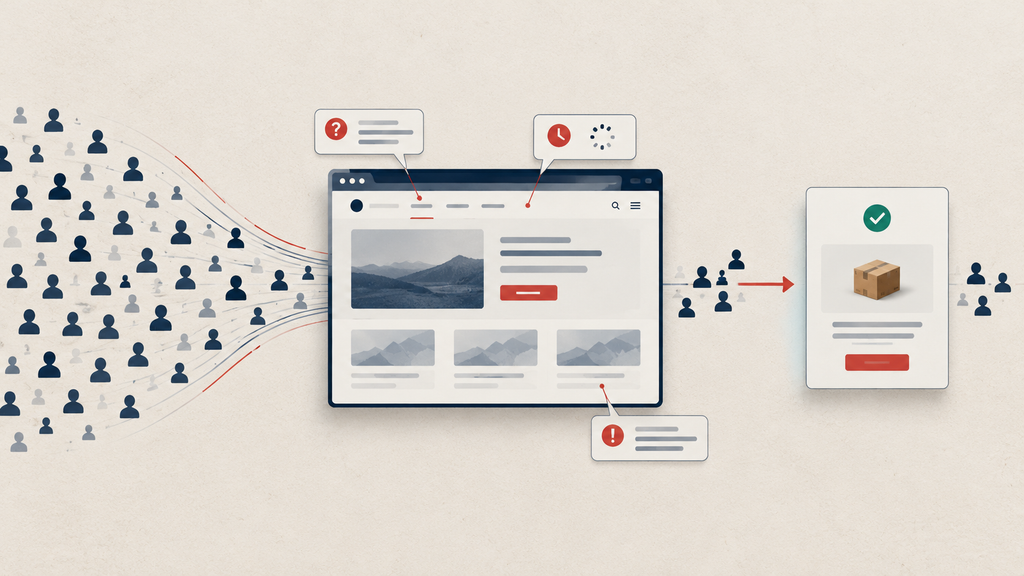
Imagine spending weeks building a website for your business. You choose the colours, write the content, add your services, and finally hit publish. Everything looks great, and people have started visiting your website.
But after a while, you notice something strange.
The traffic is coming in, but enquiries are low. People explore your pages, yet very few contact you. Your website looks professional, but it isn’t bringing the business results you expected.
So, what’s missing?
The problem might not be your product, your services, or even the number of visitors. Sometimes, the real issue is how your website communicates, performs, and guides people towards taking action.
This is where website optimization becomes important. It isn’t just about making a website look better. It means improving the overall experience so visitors can find the information they need, understand your offer, and take the next step without unnecessary confusion.
Think of your website as a digital storefront. Bringing people to the storefront is one challenge. Helping them understand what you offer and making it easy to approach your business is another.
Let’s explore nine reasons your website might not be performing as well as you expected—and what you can do about them.
1. Your Website Looks Beautiful, But Your Message Isn’t Clear
A modern design can create a great first impression. But if visitors cannot understand what your business actually does, that impression may not last very long.
Imagine landing on a software company’s website and reading this headline:
Building the Future of Digital Possibilities.
It sounds impressive, but it doesn’t tell you whether the company builds websites, mobile applications, SaaS products, or custom software.
Now imagine seeing this instead:
We design and build digital products for startups and growing businesses.
The second headline tells visitors what the company does and who it serves. They don’t have to guess.
Good website optimization starts with clear communication. Your homepage should help visitors understand three things quickly:
- What do you offer?
- Who can benefit from it?
- What should they do next?
Your message doesn’t need complicated words or exaggerated promises. It needs to communicate the value of your business in a way your audience understands.
Try this: Ask someone unfamiliar with your business to visit your homepage for five seconds. Then ask them what your company does. Their answer can reveal whether your message is clear enough.
2. Visitors Don’t Know What to Do Next
Let’s say someone visits your website, likes your work, and wants to learn more. They scroll through your homepage, check your services, and reach the bottom of the page.
Then they leave.
Why? Perhaps there was no obvious next step.
A visitor shouldn’t have to search through your entire website to figure out how to contact you or explore a service. Your pages should guide them towards a logical action.
This is where calls to action, or CTAs, come in. A CTA can be a button or link that encourages visitors to take the next step.
Examples include:
- Explore our services
- Book a consultation
- Request a quote
- Start your project
The right CTA depends on what your visitor needs. Someone who has just discovered your company may want to explore your work before booking a meeting.
Effective website optimization makes these next steps easy to find without overwhelming visitors with buttons everywhere.
Try this: Open your homepage and service pages. Can visitors easily identify what to do next? If not, make the next step more visible and specific.
3. Your Website Is Too Slow
Nobody enjoys waiting for a website to load, especially when they’re browsing on a phone or using a slower internet connection.
A page that takes too long to display its content can frustrate visitors before they even see what your business offers.
Slow performance can have several causes, including oversized images, unnecessary scripts, poorly optimised code, and excessive third-party tools. Sometimes, the problem comes from the way the website is hosted or built.
Instead of guessing, start by measuring performance.
Google PageSpeed Insights can help you identify loading problems and provide suggestions for improvement. Pay attention to the experience on mobile devices, not just your desktop browser.
Good website optimization involves making a website feel responsive and reliable. However, speed isn’t the only factor that determines whether someone becomes a customer. A fast website with confusing messaging can still struggle to generate enquiries.
The goal is to remove unnecessary friction while keeping the experience useful and accessible.
Try this: Test your homepage and your most important service page using Google PageSpeed Insights. Review the results and prioritise the issues that have the greatest impact.
4. Your Mobile Experience Feels Like an Afterthought
Your website might look perfect on a laptop, but what happens when someone opens it on a phone?
Perhaps the text is too small. Maybe the buttons are difficult to tap, the navigation menu is confusing, or the contact form requires too much scrolling.
These issues may seem minor individually, but together they can make the experience frustrating.
A mobile-friendly website isn’t simply a smaller version of a desktop website. Its layout, text, buttons, navigation, and forms should be comfortable to use on a smaller screen.
This is an important part of website optimization because visitors should be able to understand your services and complete important actions regardless of the device they use.
You don’t need to redesign every page immediately. Start with the pages that matter most to your business, such as your homepage, service pages, pricing information, and contact form.
Try this: Open your website on your phone and complete a task that a potential customer would perform. If you struggle to find information or submit an enquiry, investigate where the experience needs improvement.
5. Visitors Don’t Have Enough Reasons to Trust You
Imagine discovering a company online for the first time. Its website looks impressive, but you cannot find examples of its work, meaningful information about its services, or a clear way to contact the team.
Would you immediately trust it with an important project?
Probably not.
People often need evidence before they feel comfortable making a business decision. Your website should make it easier for them to understand who you are, what you do, and what working with you might look like.
You can build credibility through genuine project examples, relevant case studies, transparent service descriptions, accessible contact details, and honest information about your team.
If you have testimonials, use authentic ones. If you’re a new business without a large portfolio, explain your process and demonstrate your capabilities through real work.
Website optimization should never mean inventing results or making promises you cannot support. The objective is to help visitors make informed decisions by giving them useful, trustworthy information.
Try this: Review your website as if you were a potential customer who had never heard of your business. What questions would you want answered before contacting the team?
6. Your Website Attracts the Wrong Visitors
More traffic sounds great, but not every visitor is a potential customer.
Imagine a company that builds custom software for businesses. Its website receives hundreds of visits from people searching for free coding tutorials. Traffic increases, but enquiries remain low because most visitors are looking for something completely different.
The problem isn’t necessarily the website’s design. It could be a mismatch between the audience arriving on the website and the services being offered.
This is where search engine optimization, or SEO, matters.
Your content, keywords, page titles, and service descriptions should reflect what your intended audience is searching for. If your business offers custom mobile app development, your website should clearly explain that service rather than relying entirely on vague marketing language.
Website optimization and SEO work together, but they have different roles. SEO helps relevant people discover your website, while improvements to the website experience can help them understand your offer and decide what to do next.
Neither guarantees sales. Your pricing, competition, product quality, and customer needs also influence the final decision.
Try this: Review the search queries and traffic sources bringing people to your website. Ask yourself whether those visitors are likely to need the products or services you provide.
7. You’re Tracking Visitors, But Not Their Journey
Traffic is just the beginning.
Turn better experiences into meaningful growth.
Illustrative dashboard · Example figures, not actual business analytics.
Analytics dashboards can show you page views, sessions, and traffic sources. These numbers are useful, but they don’t automatically explain why visitors leave without taking action.
To understand what’s happening, you need to look at the journey people take through your website.
For example, do visitors reach your service page but leave before contacting you? Do they click your CTA but abandon the process? Are people opening your contact form but not submitting it?
These questions can help you identify specific areas that deserve attention.
A useful website optimization process begins with a problem you can investigate. Instead of redesigning an entire page because it feels outdated, examine the available evidence and identify what might be stopping visitors from completing their task.
You can then make a targeted change and measure the result.
For example, if a form requests too much information, try reducing the number of fields. If your service page doesn’t explain your process, consider adding a clearer explanation. Then compare the results over a meaningful period while accounting for changes in traffic and other factors.
Try this: Track meaningful actions such as completed enquiry forms, consultation bookings, purchases, or sign-ups. Choose metrics that reflect your business goals rather than focusing exclusively on visits.
8. Your Website and Business Have Outgrown Each Other
A website that worked well when your business first launched may not be suitable for the business you have today.
Perhaps you’ve introduced new services, expanded your team, changed your audience, or started offering more complex products. But your website still communicates an older version of your business.
You might also be dealing with inconsistent layouts, outdated content, difficult-to-maintain code, or disconnected tools that make everyday operations harder.
At this point, the problem may go beyond changing headlines or adjusting button colours.
Website optimization may require improvements to the information architecture, user experience, technical foundation, or integrations supporting your website.
For businesses exploring automation, it’s also worth understanding how AI tools and agents can support certain workflows. Our BTA article, 10 Things AI Agents Can Do That Chatbots Can’t, explores the difference between conversational tools and systems designed to carry out tasks.
That doesn’t mean every website needs AI or automation. The technology should solve a genuine problem, not be added simply because it’s trending.
Try this: List the parts of your current website or digital workflow that create repeated work, confuse customers, or prevent your team from delivering a smooth experience. Prioritise the problems that affect your business most.
9. You’re Changing Everything Instead of Fixing the Right Things
When a website doesn’t generate the expected results, it’s tempting to redesign everything at once.
A new theme, new colours, new pages, new animations, and new content can make the website feel fresh. But a complete redesign doesn’t automatically solve the underlying problem.
Perhaps visitors don’t understand your offer. Perhaps your pricing information is unclear. Perhaps your website attracts the wrong audience or makes contacting your business unnecessarily difficult.
If you don’t identify the actual issue, you might spend time and money changing the appearance without improving the experience.
A smarter website optimization strategy starts by prioritising improvements.
First, fix broken links, non-working forms, and other functional problems. Next, address confusing messages, poor navigation, and difficult user journeys. Then review performance, accessibility, search visibility, and analytics.
After that, test specific improvements and evaluate what happens.
You don’t have to solve every problem in one week. Consistent, evidence-based improvements can be more useful than making a large number of changes without understanding their impact.
Try this: Write down the three biggest problems you notice on your website. Choose one to investigate first, make a focused improvement, and measure the result before moving to the next.
Where Does 7Blocks Fit Into This?

Sometimes, a business can improve its website with a few straightforward changes. In other cases, the issues involve multiple connected areas, such as product engineering, user experience design, website performance, and digital growth.
That’s when it can be helpful to work with a team that understands both the technical side of building digital products and the experience people have while using them.
7Blocks is a digital studio based in Ahmedabad, India, that works across digital product development and growth-focused services.
Its areas of work include product engineering, UI/UX and experience design, and growth and digital enablement. Depending on a business’s requirements, these capabilities can support work ranging from building digital products to improving digital experiences and exploring areas such as SEO, conversion rate optimization, and analytics.
The important thing is to start with the problem rather than immediately deciding that you need a completely new website.
Before choosing a digital partner, understand your goals, review relevant examples of its work, discuss the scope clearly, and establish how progress will be evaluated.
Good website optimization should be connected to a real business need. The right approach for a small service business may be very different from the approach required by a growing SaaS company.
If you’re exploring ways to improve your digital presence or build a new product, you can learn more about 7Blocks and its services.
Final Thoughts: Build a Website That Works for People
A website is more than a digital business card. It can help people discover your business, understand your services, evaluate your credibility, and decide whether they want to work with you.
But those things don’t happen automatically just because a website has been published.
You need to understand your audience, communicate clearly, provide a smooth experience across devices, and make important actions easy to complete. You also need to measure what’s happening instead of assuming you already know the problem.
That is the real purpose of website optimization: making thoughtful improvements that help your website serve visitors and support your business goals.
Start small. Review your homepage, test your contact form, check your mobile experience, and investigate the pages where visitors seem to get stuck.
You may discover that a few focused changes are enough to improve the experience. Or you may find that your website needs a more comprehensive rethink.
Either way, make decisions based on evidence, not just appearance.
Because a successful website isn’t simply one that looks good. It’s one that helps the right people understand your business and take the next step.
Sources and Further Reading
- Google Search Central — SEO Starter Guide
- Google PageSpeed Insights — Test Website Performance
- web.dev — Web Vitals
- 7Blocks — Official Website
Further reading on Beyond the Algorithm: