
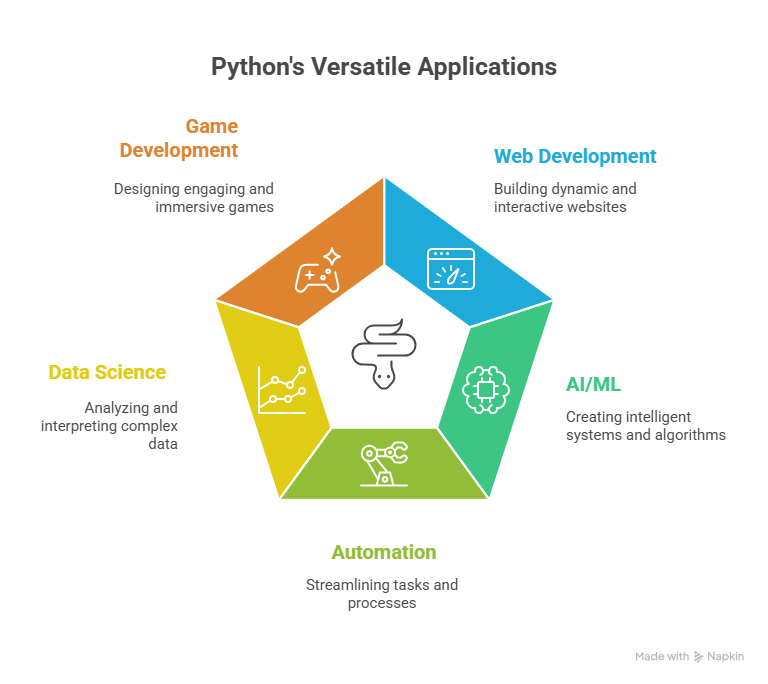
Python is a high-level programming language that lets us build applications, websites, AI/ML models, automation scripts, data analysis tools, web scraping projects, and a lot more.
Its strongest points? Simplicity and flexibility.
What Is Programming?
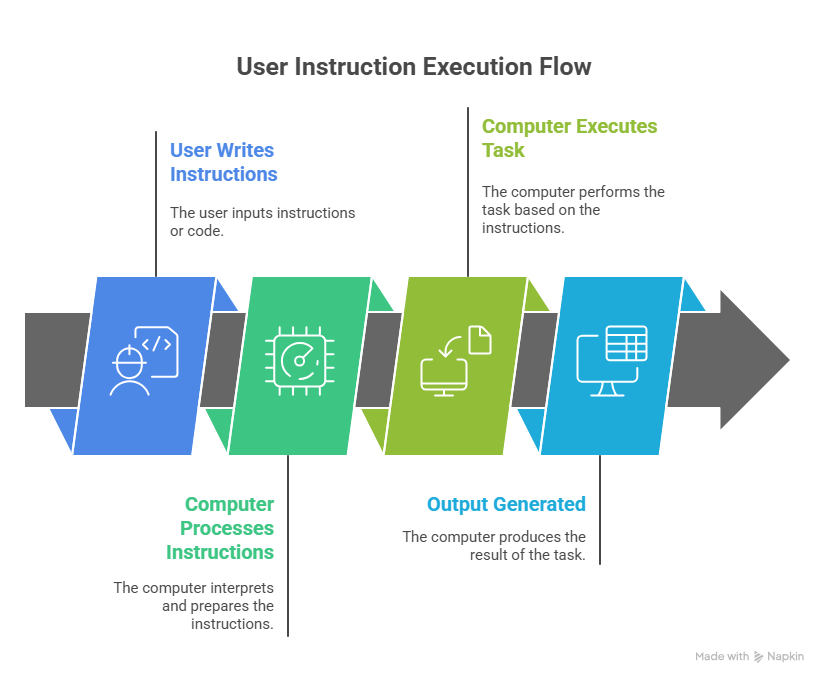
Programming basically means teaching a computer how to do a task by giving it step-by-step instructions — because honestly, a computer is no less than a little kid. It cannot think on its own; it only does whatever command you write in a programming language. Think of it like a worker who listens and follows exactly what you say.
Example:
You want the computer to add two numbers → you write the code → it runs the code → gives you the result.
So programming is basically problem-solving + logic + clear instructions.
From beginners to experts, everyone ends up choosing Python.
What Is Python?
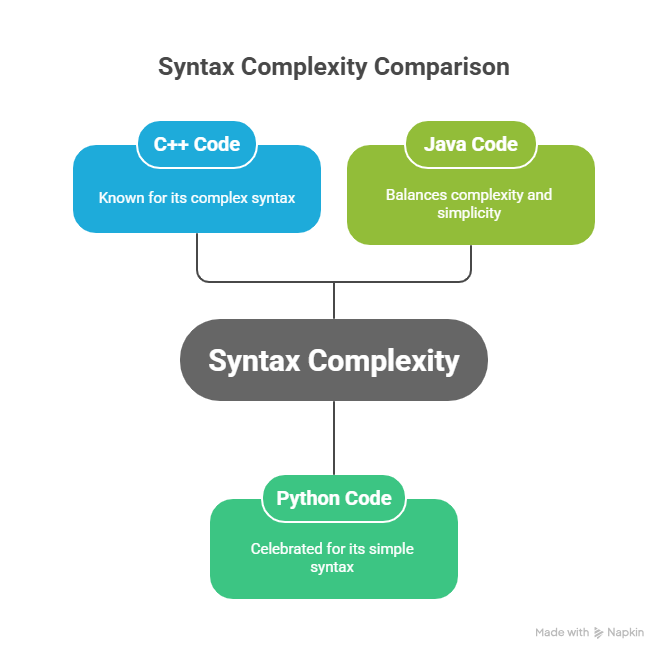
No, it’s not a snake dude, so relax. Python is a high-level, interpreted, general-purpose programming language. Its syntax looks almost like simple English, which is why beginners understand it so quickly.
Example:
Java/C++ style:System.out.println("Hello World");
Python style:print("Hello World")
Cleaner. Shorter. Easier.
And the best part? Python is used in almost every modern tech field today.
Popular Programming Languages (Explained Simply)
Python
Used for AI, ML, data science, automation, scripting, and web development.
Basically the all-rounder kid who tops every subject without trying too hard.
JavaScript
Runs the entire web — frontend, backend (Node.js), and web apps.
If the internet had a heartbeat, it would be this language.
Java
Used in enterprise software, banking systems, and Android apps.
The serious, disciplined student who always submits assignments on time.
C/C++
Perfect for operating systems, embedded systems, and high-performance apps.
The gym freak of programming — tough but insanely strong.
SQL
Handles databases, data analysis, and backend data work.
The “data manager” who knows exactly where every file is stored.
Go & Rust
Built for super fast, efficient backend and system-level development.
The new cool kids — fast, sharp, and slightly intimidating.
Each language has its purpose, but Python stays the most beginner-friendly and versatile — the one that doesn’t scare you on day one.
5. Why Python?
Very Easy to Learn
Python code is so clean that beginners look at it and go:
“Oh wow… I can actually understand this.”
It’s literally the least dramatic language out there.
Huge Libraries
Python has thousands of powerful libraries for:
- AI / ML
- Data analysis
- Automation
- Web development
- Computer vision
- Cybersecurity
- Game development
Libraries like NumPy, Pandas, TensorFlow, Flask, Django are basically Python’s superpowers.
Why struggle when shortcuts already exist?
Fast Development
Less code = faster work.
While other languages are still fixing syntax errors, Python developers are already done and drinking chai.
High Job Demand
AI, automation, and data science rely heavily on Python.
As long as smart tech exists, Python will stay relevant.
Extremely Versatile
With one language, you can build:
- Websites
- Applications
- Bots
- ML models
- Automation scripts
- APIs
- Games
- Security tools
- Dashboards
Python is that one friend who’s good at everything — and actually delivers.
6. Career With Python
Python opens up many career paths, and none of them are boring.
Python Developer
Works on backend apps, APIs, and automation — the “gets things done” role.
Data Analyst
Cleans and analyzes data, builds reports, and finds insights normal humans miss.
Machine Learning Engineer
Trains ML models and builds predictive systems — teaches computers how to think.
AI Engineer
Creates AI tools, chatbots, recommendation systems — makes apps feel smart.
Web Developer (Django / Flask)
Builds backend logic for websites.
Without them, your fave apps would just look pretty and do nothing.
Automation Engineer
Creates scripts and bots to remove boring tasks.
Office workers love them. Interns fear them.
Cybersecurity & Tools Developer
Makes security tools that protect systems.
Sources & References
1. Python — Official Documentation
Link: https://www.python.org
The official Python documentation, tutorials, and resources straight from the creators. Perfect for understanding Python features, libraries, and updates.
2. Stack Overflow Developer Survey 2025
Link: https://survey.stackoverflow.co/2025
Shows Python as one of the top 3 most used programming languages worldwide. Highlights trends, developer preferences, and real-world usage.
3. GitHub Octoverse Report 2024
Link: https://github.blog/news-insights/octoverse/octoverse-2024/
Tracks open-source activity on GitHub. Python consistently ranks among the most popular languages in terms of repositories, contributions, and stars.
4. TIOBE Index 2025 — Programming Community Index
Link: https://www.tiobe.com/tiobe-index/
Python frequently ranks #1 globally in programming language popularity. Provides monthly ranking based on search engine hits and developer activity.
5. JetBrains Python Developers Survey 2020
Link: https://www.jetbrains.com/lp/python-developers-survey-2020/
Highlights Python’s dominance in AI, ML, automation, and web development. Gives insights into usage patterns, libraries, and career trends.
❓ FAQs (Frequently Asked Questions)
Short, useful, and beginner-friendly — perfect for blogs or posts.
1. Is Python good for beginners?
Yes. Python’s syntax is simple, readable, and less confusing than Java, C++, or JavaScript.
It’s basically the “gentle entry gate” into tech.
2. Do I need math to learn Python?
For basic Python and development → No.
For AI/ML → Basic math helps, but you can learn it along the way.
3. How long does it take to learn Python?
- Basics: 1–2 months
- Projects: 2–3 months
- Job-ready: 4–6 months (with practice + portfolio)
4. Can I get a job just by learning Python?
Yes, but only if you learn:
✔ Python basics + advanced
✔ Projects
✔ GitHub
✔ APIs
✔ One specialization (AI, Data, Web, Automation)
5. Python ya Java — which one is better?
Different use cases.
Python = AI, ML, data, automation
Java = enterprise apps, banking, Android
For beginners → Python is easier and more flexible.
6. Python se kitna salary mil sakti hai?
Depends on the field:
- Python Developer: ₹4–12 LPA
- Data Analyst: ₹4–10 LPA
- ML Engineer: ₹6–18 LPA
- AI Engineer: ₹8–25 LPA
Skill + projects = better salary.
7. Which Python field has the highest demand?
Right now:
- AI & ML
- Automation
- Backend development
- Data science
8. Can I learn Python without a laptop?
You can, but you’ll be very limited.
A laptop makes learning 10x faster and practical.
9. Which IDE should I use?
For beginners: VS Code
For data science: Jupyter Notebook
For full-stack: PyCharm/VS Code
10. What projects can I build as a beginner?
- Calculator
- To-do app
- Web scraper
- Weather app
- Automation bot
- Mini AI chatbot
- Password manager
- Movie recommendation system
Nice nice
thank you