Machine learning concepts what it is ?If you’re starting your AI journey, you’ve probably noticed one term appearing almost everywhere: machine learning. From chatbots and recommendation systems to image recognition and fraud detection, so many technologies we use today depend on it. But when you actually start learning about it, things can get confusing pretty quickly. Suddenly you come across terms like supervised learning, unsupervised learning, semi-supervised learning, self-supervised learning, reinforcement learning, classification, regression, and clustering. And then comes the obvious question: are all of these different things, or are they somehow connected?
The answer is that they are connected, but they describe different ways of learning, different types of tasks, and different parts of the model-building process. So instead of memorizing random definitions, let’s connect these machine learning concepts and understand where each one fits.
1. Supervised Learning
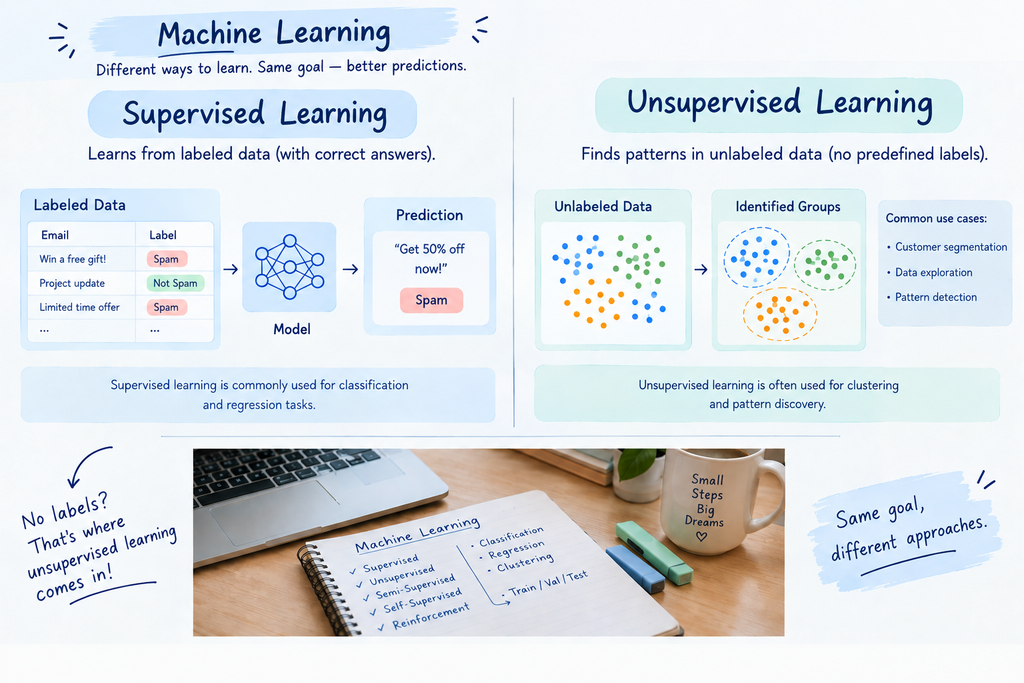
Imagine you are learning with a teacher who gives you questions along with their correct answers. You solve the questions, compare your answers with the provided answers, understand your mistakes, and gradually get better. Supervised learning works with a similar idea. The model is trained using data where the correct output, or label, is already known. It learns the relationship between the input and the expected output and then uses what it has learned to make predictions on new data.
For example, imagine a dataset containing thousands of emails labeled as either “spam” or “not spam.” During training, the model sees both the emails and their corresponding labels. After learning from enough examples, it can receive a completely new email and predict whether it is likely to be spam. This is one of the most common forms of machine learning and is used for tasks where we already have examples of the answers we want the model to learn.
Two common tasks associated with supervised learning are classification and regression. Classification is used when the output is a category, while regression is used when the output is a numerical value.
Among the most important machine learning concepts for beginners, supervised learning is usually the easiest place to start because the learning process is straightforward: the model receives examples along with their correct answers. Once you understand this basic idea, many other learning approaches become easier to compare.
2. Unsupervised Learning
Now imagine removing the answer key completely. You give the model a large amount of data, but you don’t tell it what the correct categories or answers are. Instead, the model tries to discover useful patterns or structures within the data on its own. This is the basic idea behind unsupervised learning.
For example, imagine a company has information about thousands of customers, including their purchases, browsing habits, and spending patterns. Nobody has manually labeled these customers into groups. An unsupervised algorithm can analyze their behavior and discover groups of customers who behave similarly. The company might then use these groups for customer segmentation or personalization.
This is an important difference to remember: supervised learning learns from labeled examples, while unsupervised learning tries to discover patterns in data without predefined labels. Clustering is one of the most common examples of an unsupervised machine learning task.
When connecting different machine learning concepts, unsupervised learning is important because it shows that a model doesn’t always need predefined answers. Instead, it can explore the data and find patterns or relationships that may not have been identified beforehand.
3. Semi-Supervised Learning
Here is where things become a little more interesting. What if you have a huge dataset, but only a small portion of it is labeled? Manually labeling every example could take a lot of time, money, or human effort. Semi-supervised learning addresses this situation by using both labeled and unlabeled data during the learning process.
Imagine having 10,000 images but only 500 of them have been manually labeled. Instead of throwing away the other 9,500 images, a semi-supervised approach can use information from both sets. The labeled examples provide direct guidance, while the much larger collection of unlabeled examples can also contribute useful information.
This makes semi-supervised learning particularly interesting when labeled data is expensive to obtain but unlabeled data is relatively easy to collect. In simple terms, you can remember it as a middle ground: supervised learning uses labeled data, unsupervised learning works without predefined labels, and semi-supervised learning uses a combination of both.
Semi-supervised learning adds an interesting layer to the machine learning concepts we have discussed so far. It becomes useful when you have some labeled data available but also have a much larger collection of unlabeled data that you don’t want to ignore.
4. Self-Supervised Learning
Self-supervised learning sounds similar to semi-supervised learning, but the underlying idea is different. Instead of depending on manually created labels, the model creates a learning signal from the data itself. This means that a huge amount of unlabeled data can be turned into a useful training resource.
Think about a sentence where one word is hidden: “The cat is sitting on the ___.” The model can be trained to predict the missing word based on the surrounding words. Nobody had to manually label that sentence as “correct” or “incorrect.” The structure of the original data itself created the learning task.
This approach has become especially important in modern AI because there are enormous amounts of text, images, audio, and other data available on the internet. Manually labeling all of that information would be unrealistic. Self-supervised learning allows models to learn useful representations from large amounts of raw data before they are adapted to specific tasks.
If you are learning about modern AI systems, self-supervised learning is a concept worth understanding because it helps explain how models can learn from massive datasets without every piece of data needing a human-generated label.
One of the more interesting machine learning concepts to understand today is self-supervised learning because it changes how we think about labels. Instead of depending completely on humans to label data, the model can create its own learning signal from the information already present in the data.
5. Reinforcement Learning
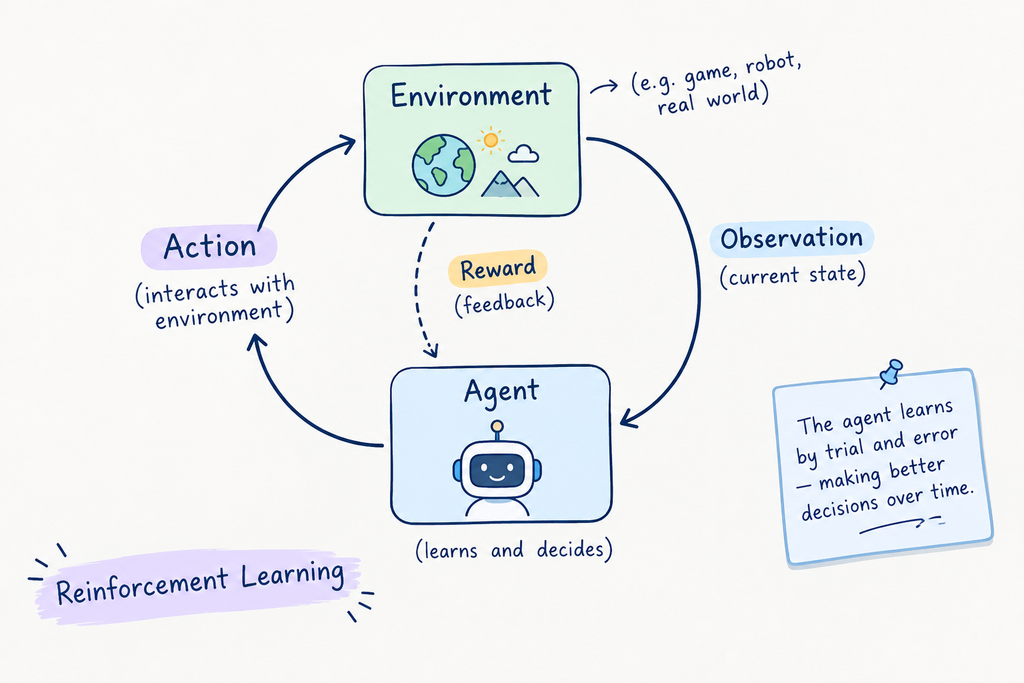
The previous approaches mainly involve learning from datasets. Reinforcement learning takes a different route. Instead of simply being given examples, an agent interacts with an environment, takes actions, and receives feedback based on those actions.
Imagine teaching an AI to play a game. The AI tries an action, observes what happens, and receives a reward or penalty depending on the outcome. It repeats this process many times and gradually learns which actions tend to produce better results.
The important idea here is not simply “find the correct answer.” Instead, the system is trying to learn which actions can lead to better outcomes over time. This makes reinforcement learning useful for problems involving decision-making, control, and sequential actions.
A simple way to remember the difference is this: supervised learning learns from labeled examples, unsupervised learning searches for patterns, and reinforcement learning learns through interaction and feedback.
Reinforcement learning connects with other machine learning concepts in a different way because the model learns through interaction rather than simply studying a fixed collection of examples. This makes it particularly interesting for situations where decisions and their consequences matter.
6. Classification
Classification is not a separate learning approach in the same way that supervised or unsupervised learning is. Instead, it describes a type of prediction task. In classification, the model tries to place an input into a particular category.
Think about an email spam detector. Its output could be “spam” or “not spam.” A medical system might classify an image into different diagnostic categories, while another system could classify a transaction as legitimate or potentially fraudulent. In each case, the output represents a category rather than a continuous numerical value.
Classification is commonly associated with supervised learning because the model normally needs labeled examples during training. When there are only two possible categories, it is called binary classification. When there are several possible categories, it can be referred to as multiclass classification.
Classification is one of the most practical machine learning concepts because you encounter this type of prediction in many everyday systems. Whenever a model needs to decide which category an input belongs to, classification can become part of the solution.
7. Regression
Regression is another common prediction task. Unlike classification, where the output is a category, regression is used when the model needs to predict a numerical value.
For example, imagine trying to estimate the price of a house. You could provide information such as its size, location, number of rooms, and other features. The target value would be the house price. The model learns relationships between these features and the target and then uses those relationships to estimate the price of another house.
The easiest way to remember the distinction is simple: classification predicts a category, while regression predicts a numerical value. Both can be important parts of machine learning projects, depending on the problem you are trying to solve.
Regression is another fundamental machine learning concepts topic to understand because not every prediction problem has a category as its answer. Sometimes the goal is to estimate an actual numerical value, which makes regression different from classification even though both involve prediction.
8. Clustering
Clustering is one of the most common ideas associated with unsupervised learning. The goal is to group similar data points together without giving the model predefined categories.
Imagine a music platform with thousands of users. Instead of manually telling the system which users prefer rock, pop, classical, or electronic music, a clustering algorithm can examine listening behavior and discover groups of users with similar patterns. The groups are created from similarities in the data rather than from labels provided beforehand.
This is why clustering can be useful when you don’t already know what categories exist. Instead of telling the model what groups to find, you allow the algorithm to explore the data and identify structures that may not be obvious at first.
Clustering helps connect several machine learning concepts together because it is a clear example of how a model can discover structure without being given predefined categories. Instead of telling the algorithm what groups should exist, we allow the patterns in the data to guide the grouping process.
9. Training, Validation and Test Data
Understanding how data is divided is another important part of machine learning. When we build a model, we don’t normally want to train it and evaluate it using exactly the same data. If we did that, the model could perform extremely well on examples it has already seen without actually being good at handling new ones.
This is why datasets are often divided into training, validation, and test sets. Training data is used to teach the model and help it learn patterns. Validation data can be used during development to tune choices and compare different approaches. Test data is kept for evaluation so that we can see how the final model performs on examples that it did not train on.
Think about it like preparing for an exam. If you study the exact questions that will appear in the exam and then test yourself using those same questions, getting a high score doesn’t necessarily prove that you understand the subject. You might simply remember the answers. Testing on new questions gives you a much better idea of whether you actually learned the concepts.
The same basic idea applies to machine learning models. Performance on unseen data helps us understand whether a model can generalize beyond the examples it was trained on.
Understanding training, validation, and test data completes another important part of the machine learning concepts beginners need to know. Learning how a model is trained is only one part of the process; understanding how we evaluate whether it works on unseen data is equally important.
How Do These Machine learning Concepts Fit Together?
At first, these nine concepts can look like completely separate topics, but they actually describe different layers of the same bigger picture. Supervised, unsupervised, semi-supervised, self-supervised, and reinforcement learning describe different ways a system can learn. Classification, regression, and clustering describe common tasks that models can perform. Training, validation, and test data describe how we organize data while developing and evaluating those models.
For example, classification can be a supervised task because the model can learn from labeled examples. Clustering is commonly associated with unsupervised learning because the algorithm tries to discover groups without predefined labels. A modern AI system can also use self-supervised learning during an initial training stage and later be adapted to a specific supervised task.
This is why simply memorizing definitions isn’t enough. When you see a new AI project, try asking two questions: “How is the model learning?” and “What is the model trying to do?” Those questions can help you place many of these concepts into the right context.
Once you start looking at them this way, machine learning concepts stop feeling like isolated definitions and start becoming pieces of the same puzzle. A model can learn from labeled or unlabeled data, discover patterns, make predictions, or learn through feedback depending on the problem. The important part is not remembering which definition belongs to which term, but understanding why a particular approach is used for a particular problem. Once that connection becomes clear, reading about new AI models and projects becomes much easier because you can start identifying where each idea fits instead of treating every new term as something completely new.
A Quick Comparison of all the Machine learning concepts
| Concept | Main idea | Common example |
|---|---|---|
| Supervised learning | Learns from labeled examples | Spam detection |
| Unsupervised learning | Finds patterns without predefined labels | Customer grouping |
| Semi-supervised learning | Uses labeled and unlabeled data | Image classification with limited labels |
| Self-supervised learning | Creates learning signals from the data itself | Language model pre-training |
| Reinforcement learning | Learns through actions and feedback | Game-playing agent |
| Classification | Predicts a category | Spam or not spam |
| Regression | Predicts a numerical value | House price prediction |
| Clustering | Groups similar data points | Customer segmentation |
| Training/validation/test | Organizes data for learning and evaluation | Model development |
Don’t Confuse Semi-Supervised With Self-Supervised
This is probably one of the easiest places to get confused. Semi-supervised learning still uses some human-labeled data along with unlabeled data. Self-supervised learning, on the other hand, creates the learning signal from the data itself.
So even though the names sound similar, they solve slightly different problems. Semi-supervised learning asks, “How can I make use of both my labeled and unlabeled data?” Self-supervised learning asks, “How can I create a useful learning task from the data I already have?”
Once you understand this difference, the terminology becomes much easier to follow when you start reading about modern AI systems.
If you’re building your AI vocabulary alongside these concepts, you can also check out my earlier article, 27 AI Terms Every Beginner Should Know, where I break down other important AI terminology in a beginner-friendly way.
Final Thoughts
When you first start learning machine learning, the terminology can seem much bigger than the actual ideas behind it. But once you understand how different machine learning concepts connect with each other, the subject becomes much easier to organize in your head.
Supervised learning works with labeled examples, while unsupervised learning looks for patterns without predefined labels. Semi-supervised learning uses both labeled and unlabeled data, whereas self-supervised learning creates learning signals from the data itself. Reinforcement learning takes a different approach by learning through interaction and feedback. Alongside these learning approaches, you also have important machine learning concepts such as classification, regression, and clustering, as well as training, validation, and test data. Understanding how these ideas fit together is much more useful than simply memorizing their definitions.