So far, we learned:
- Operators
- Conditional Statements
Now comes something powerful.
🔁 Loops in Python
This is where your code stops doing things once…
and starts repeating like your favorite song on loop.
Except this time, repetition is useful.
🔹 What Are Loops in Python?
A loop allows you to execute a block of code multiple times.
Instead of writing:
print("Hello")
print("Hello")
print("Hello")
You write:
for i in range(3):
    print("Hello")
Smarter. Cleaner. Less embarrassing.
🔹 Why Are Loops Important?
Without loops:
- No automation
- No iteration over lists
- No game levels
- No data processing
You’d be manually repeating code like it’s 2005.
🔹 Types of Loops in Python
Python has two main loops:
- for loop
- while loop
That’s it.
Simple language. Powerful results.
1️⃣ The for Loop in Python
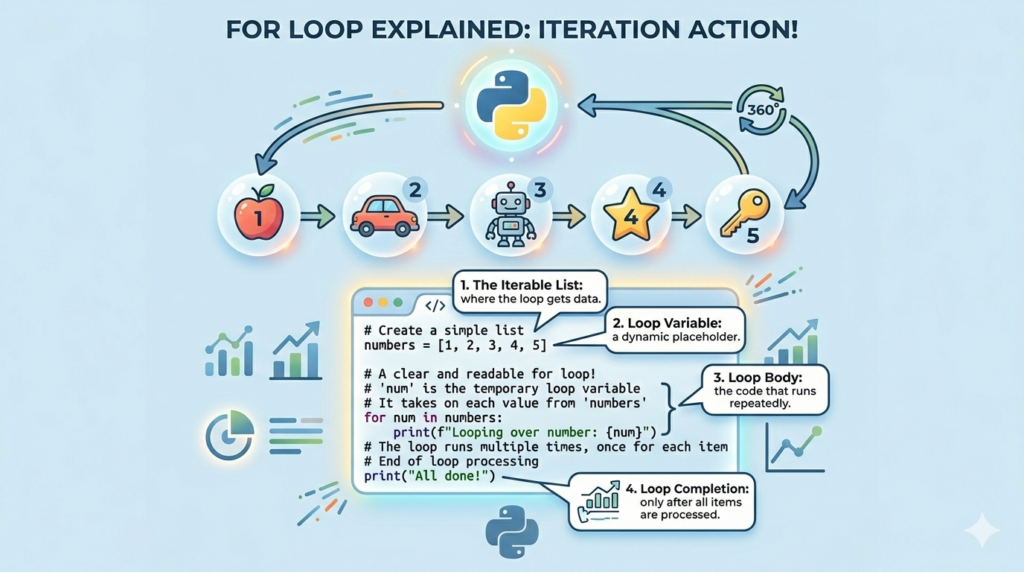
Used when you know how many times you want to repeat something.
Example: Print Numbers 1 to 5
for i in range(1, 6):
    print(i)
Output:
1 2 3 4 5
range(1,6) means:
Start at 1
Stop before 6
Python is very specific.
Real-Life Example
Imagine taking attendance:
students = ["Aman", "Riya", "Kabir"]for student in students:
    print(student)
Loop checks each student one by one.
Like a teacher calling names.
Except Python never mispronounces.
2️⃣ The while Loop in Python
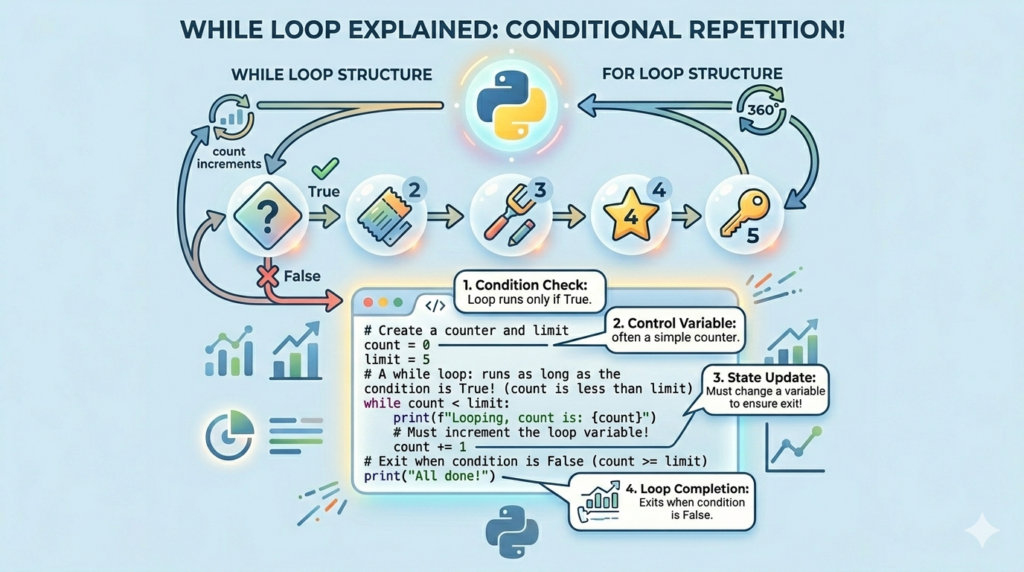
Used when you don’t know how many times the loop should run.
It runs until the condition becomes False.
Example:
count = 1while count <= 5:
    print(count)
    count += 1
Important line:count += 1
Without it?
You just created an infinite loop.
And your laptop fan starts sounding like a helicopter.
🔥 Infinite Loop (The Beginner Classic)
while True:
    print("Help")
This runs forever.
Unless you stop it manually.
Please don’t test this during an exam.
🔹 break and continue in Loops
break
Stops the loop completely.
for i in range(10):
    if i == 5:
        break
    print(i)
Loop ends at 5.
Break means:
“I’m done. I’m leaving.”
continue
Skips current iteration.
for i in range(5):
    if i == 2:
        continue
    print(i)
2 will not print.
Continue means:
“Skip this one.”
🔹 Nested Loops
Loop inside a loop.
Yes. It gets serious.
for i in range(3):
    for j in range(2):
        print(i, j)
Used in:
- Pattern printing
- Matrix operations
- Games
Be careful.
Nested loops increase execution time.
More loops = more power.
But also more responsibility.
🚨 Common Beginner Mistakes in Loops
❌ 1. Forgetting to Update Variable in while Loop
while count <= 5:
    print(count)
No increment.
Infinite loop unlocked.
❌ 2. Wrong range Values
for i in range(5):
    print(i)
Beginners expect 1 to 5.
They get 0 to 4.
Python starts counting from 0.
It’s not wrong.
You assumed.
❌ 3. Bad Indentation
for i in range(3):
print(i)
IndentationError.
Python doesn’t forgive this.
❌ 4. Using break Incorrectly
Placing break outside condition accidentally ends loop early.
Test logic properly.
❌ 5. Overcomplicating Loops
Writing 15 lines when 3 lines were enough.
Simple code > dramatic code.
🔗 Source Links
Here are trusted references:
- W3Schools Python Loops – https://www.w3schools.com/python/python_for_loops.asp
- GeeksforGeeks Python Loops Guide – https://www.geeksforgeeks.org/loops-in-python/
Always check official docs when confused.
StackOverflow is helpful.
But not always correct.
❓ 10 Frequently Asked Questions About Loops in Python
1️⃣ What is a loop in Python?
A loop repeats a block of code multiple times.
2️⃣ What is the difference between for and while?
for → fixed number of iterations
while → runs until condition becomes False
3️⃣ What is range()?
range() generates a sequence of numbers.
4️⃣ Why does range(5) start from 0?
Because Python uses zero-based indexing.
5️⃣ What is an infinite loop?
A loop that never ends because the condition never becomes False.
6️⃣ How do I stop a loop early?
Use break.
7️⃣ What does continue do?
Skips current iteration and moves to next one.
8️⃣ Can we use if inside loops?
Yes. Very common and powerful combination.
9️⃣ What are nested loops used for?
Patterns, grids, matrices, complex iterations.
🔟 Are loops slow?
They can be if:
- You use too many nested loops
- You process huge datasets inefficiently
Optimize when necessary.
Final Thoughts
If you understand:
- for loop
- while loop
- range()
- break
- continue
- infinite loops
- indentation
Then you now control repetition in Python.
That’s serious progress.
Loops + Conditions together = Real logic building.