Weird, isn’t it? We know we’re interested in AI… we know we want to study it…
but when it comes to what exactly to study in AI — it’s pure chaos! And trust me, my friends, I’ve been through that exact same frustration.
So come on, let’s cry a little together—Wait, wait! Just kidding don’t run away! After wandering here and there, scrolling endlessly, getting lost in hundreds of “AI roadmaps,” I finally figured out what to study and how to move step by step into the world of Artificial Intelligence. And yes, I know I’m smart (obviously ), so if I built this course, it has to be effective! How will you know it works?
BY FOLLOWING IT
Because you can’t finish something by starting it — you finish it by finishing it. Simple.
My AI Learning Plan (Made for Students Like Me)
This roadmap isn’t some fancy thing I copied — it’s built from my own confusion, mistakes, and experiments.
So if you’re someone like me who’s stuck wondering “Where do I even start?”, this is for you. Yes, I was also lost in that messy AI jungle… but this time, I’m not just walking through it — I’m following it seriously.I’ll be writing a blog for every single topic
teaching, learning, and growing together with all of you lovely people who are also curious (and maybe a little frustrated ). What You’ll Get Here. This isn’t just a roadmap — it’s our full journey from beginner to pro. I’ve divided it into 6 clear, practical phases that take you from
“I don’t even know what AI is” → to → “I can build my own AI projects!”. Each phase focuses on fun learning, real projects, and simple explanations that actually make sense. A Promise to Myself (and You). This time, I, Rutvika Goswami, am not just sharing this roadmap.
I’m going to follow it with you, step by step. So that all of us, together, can finally understand Artificial Intelligence most practically and excitingly possible. By the way, if you find AI definitions confusing (trust me, they are in the beginning), I’ve already explained them in my previous blog — go check that out first!
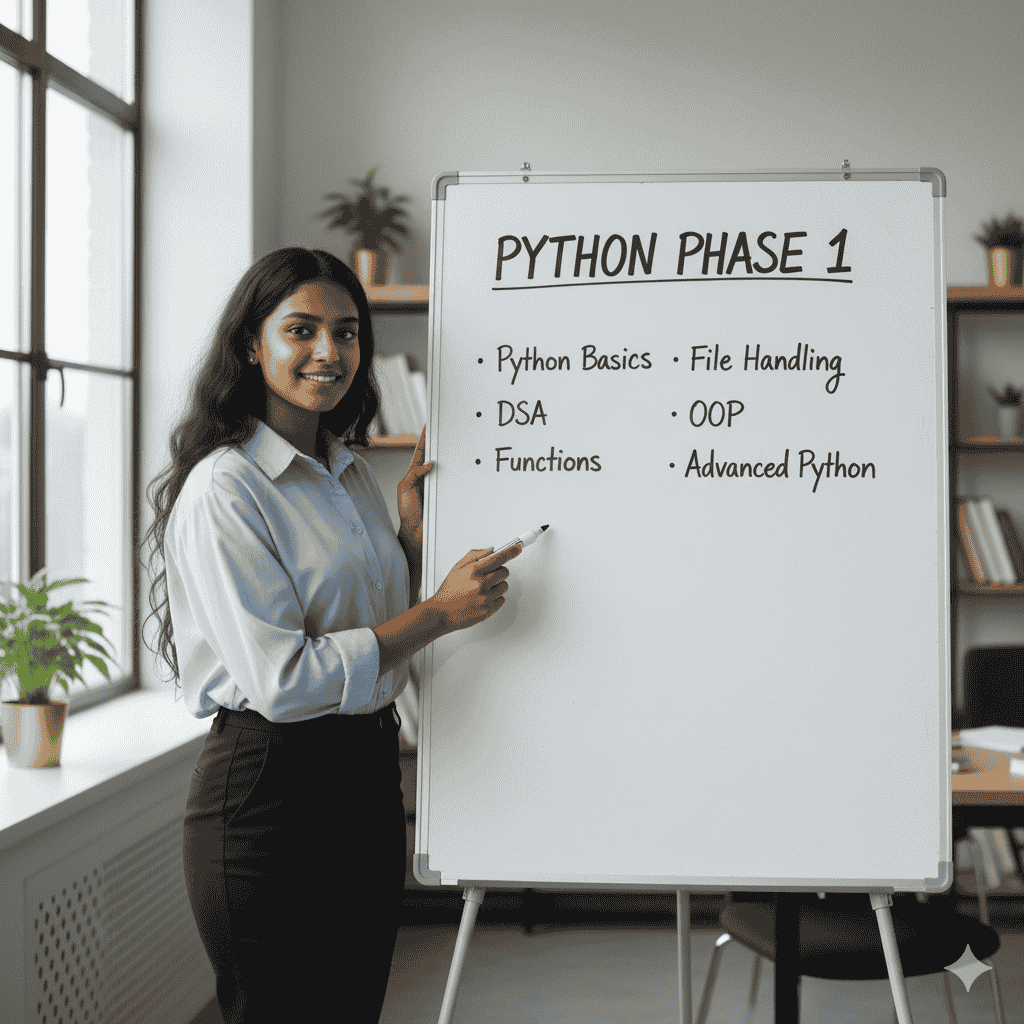
Phase 1: Python Basics — The Real Beginning of AI
So here we go! In this phase, we’re gonna learn (hehe I mean read 😜) all the basics of Python — the language that makes AI actually come alive.
💡 1. Python Basics
Let’s see what we’ll explore 👇
Topics:
- Variables, Data Types (int, float, string, bool)
- Operators (Arithmetic, Logical, Comparison)
- Input/Output, Comments
- Type Casting
- Conditional Statements (if-elif-else)
- Loops (for, while, nested loops) ← just don’t get lost inside them, okay? 😭 Build: Calculator: Don’t worry, this one only counts numbers, not your mistakes.
Number Guessing Game: Since we can’t guess what’s happening in life, let’s at least guess numbers.
Pattern Printer: Sadly, this one can’t tell you what pattern your life is following. 😅
Now look — many people say “DSA is boring” (and yeah, sometimes it feels that way 😩).
But trust me, it’s absolutely essential for logic-building and a strong coding foundation.
2. Data Structures
Topics:
- Strings (slicing, methods)
- Lists (append, extend, slicing)
- Tuples, Sets, Dictionaries
- List comprehension
- Dictionary comprehension Build: Student Record Manager
Word Frequency Counter
3. Functions (Very Important)
Okay, confession time — when I first started learning Python, functions were my most irritating topic.
But maybe while writing this, I’ll fall in love with them… and you might too. 💔→💖
Topics:
- Function definition, return
- Parameters & arguments
- Default & keyword arguments
- Lambda functions
- Recursion
- Map, filter, reduce (functional programming) Build:
Password Generator
Recursive Factorial/Fibonacci
Mini Automation Script (rename files, move images automatically)
4. File Handling + Modules
Now imagine you’ve learned everything — but where do you store or manage all that data?
That’s exactly what this part teaches.
Topics:
- Read/Write text & CSV files
- Import & use libraries
- Create custom modules
- JSON basics Build:
Notes Saver using file handling
JSON-based To-Do App
5. Object-Oriented Programming (OOP)
Ah yes — the topic that people pretend is hard. Spoiler alert: it’s not.
I literally finished it in a day. 😎
Topics:
- Classes & Objects
- Constructors (init)
- Methods, Inheritance
- Polymorphism, Encapsulation, Abstraction Build: Bank Account System (though we all know there’s no money in it anyway 😂)
Library Management System (have you ever actually seen a library lately?)
6. Exception Handling & Advanced Python
This one’s like Python’s “grown-up” stage — where you start handling errors gracefully instead of panicking.
Topics:
- Try/Except, Finally
- Custom exceptions
- Decorators
- Generators, Iterators
- Virtual environments
- APIs (requests library basics) Build:
Weather App using API
File Organizer Script Final Words for Phase 1
Alright team — first, we’ll finish this phase properly before jumping anywhere else.
Once we’re done mastering this, I’ll sit down with you again for Phase 2 — where we’ll dive into the real AI world: Data, Math, and Logic Building.
So buckle up — because this time, we’re not running away after starting.
We’re finishing what we start.
📚 Sources and References
- Google AI Education – https://ai.google/education/
- IBM Machine Learning Guides – https://www.ibm.com/topics/machine-learning
- Kaggle Learn – https://www.kaggle.com/learn
- Coursera – AI for Everyone by Andrew Ng
- OpenAI Learning Resources – https://openai.com/
- Towards Data Science – https://towardsdatascience.com/
Pingback: Why Does AI Hallucinate? Understanding 1)AI Hallucinations and 2)Confidently Wrong Answers - Beyond The Algorithm