Hey, let’s start with a simple question.
Have you ever asked ChatGPT to explain a difficult topic, used an AI tool to create an image, or watched a tool turn a few lines of text into a video? All of these feel a little magical at first. You type a few words, press Enter, and something new appears.
That’s where Generative AI comes in. You’ll hear the term everywhere, but the idea behind Generative AI is simpler than it sounds.
But don’t worry—we’re not going to throw complicated equations at you. We’ll break the idea down like we’re discussing it over chai.
So, What Is Generative AI?
Generative AI is a type of artificial intelligence that learns patterns from examples and uses what it has learned to create new content. That content could be text, images, music, audio, video, or even computer code.
Think of it this way: a traditional image-classification model might look at a picture and tell you, “This is a cat.” A generative model can take a prompt like “Create an orange cat wearing a space suit” and produce a new image that matches the description.
The important word here is generate. Instead of only recognising or predicting something about existing data, Generative AI can produce an output of its own based on patterns learned during training.
And no, that doesn’t mean it thinks exactly like a human. It means the model has learned statistical patterns and relationships from data and can use them to make new outputs.
How Does It Learn to Create Things?
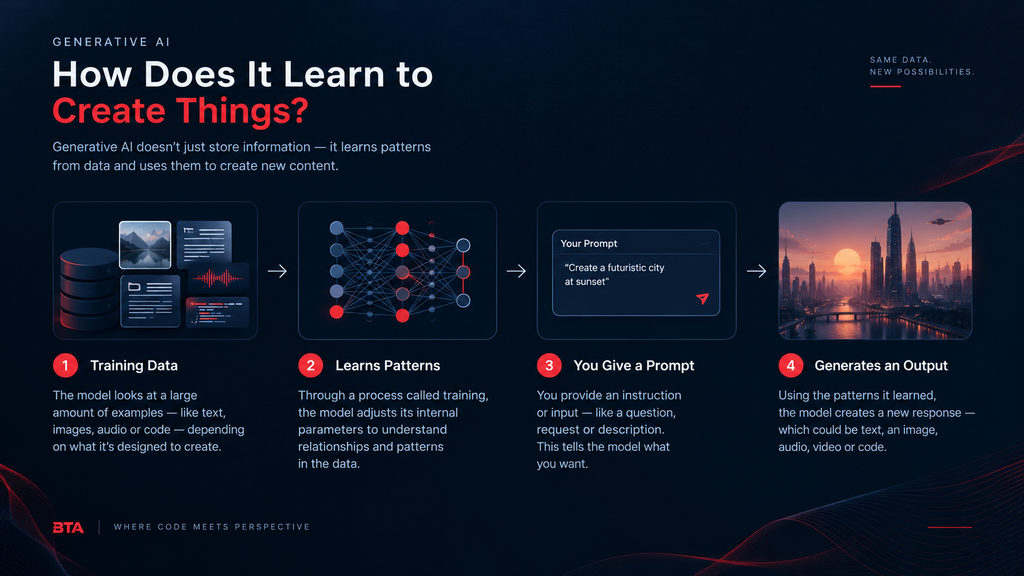
Let’s use a simple example. Imagine you want to learn what makes a good story. You read lots of stories and gradually notice patterns: how characters are introduced, how problems appear, and how endings work.
A model learns in a different, mathematical way, but the analogy helps us understand the basic idea.
1. It learns from data
During training, a model processes examples such as text, images, audio, or code. The type of data depends on what the model is designed to do, because Generative AI models are trained for different kinds of outputs.
2. It learns patterns
The model’s training process adjusts its internal parameters so it can capture useful relationships in the data. A language model, for example, learns patterns in how words and tokens appear together.
3. You give it a prompt
A prompt is the instruction or input you provide when interacting with a Generative AI tool. You might ask for a blog outline, a Python explanation, or an image of a city on Mars.
4. It generates an output
The model uses the patterns it learned to produce a response. Different models do this in different ways: some generate text piece by piece, while image-generation models may gradually transform noise into an image.
That’s the basic idea behind Generative AI: learn patterns during training, then use those learned patterns to generate something when given an input.
What Can It Actually Create?
You’ve probably already seen more examples of Generative AI than you realise.
- Text: explanations, summaries, stories, emails, and blog drafts.
- Images: illustrations, concept art, product mock-ups, and visual ideas.
- Audio: speech, sound effects, and music.
- Video: short clips, animations, and scenes generated from prompts or other inputs.
- Code: code suggestions, functions, test cases, and explanations of programming problems.
These abilities can overlap. Some systems can accept text and images together, then respond with text or another type of output. You may hear these called multimodal models.
If some of these terms sound unfamiliar, keep our 27 AI Terms Every Beginner Should Know guide handy. It breaks down the vocabulary without making you feel like you accidentally opened a research paper.
Are All Generative AI Models the Same?
Nope—and this is where things get interesting.
Different Generative AI models learn and generate content using different approaches. You don’t need to memorise every technical detail right now, but knowing the broad differences makes the field much easier to follow.
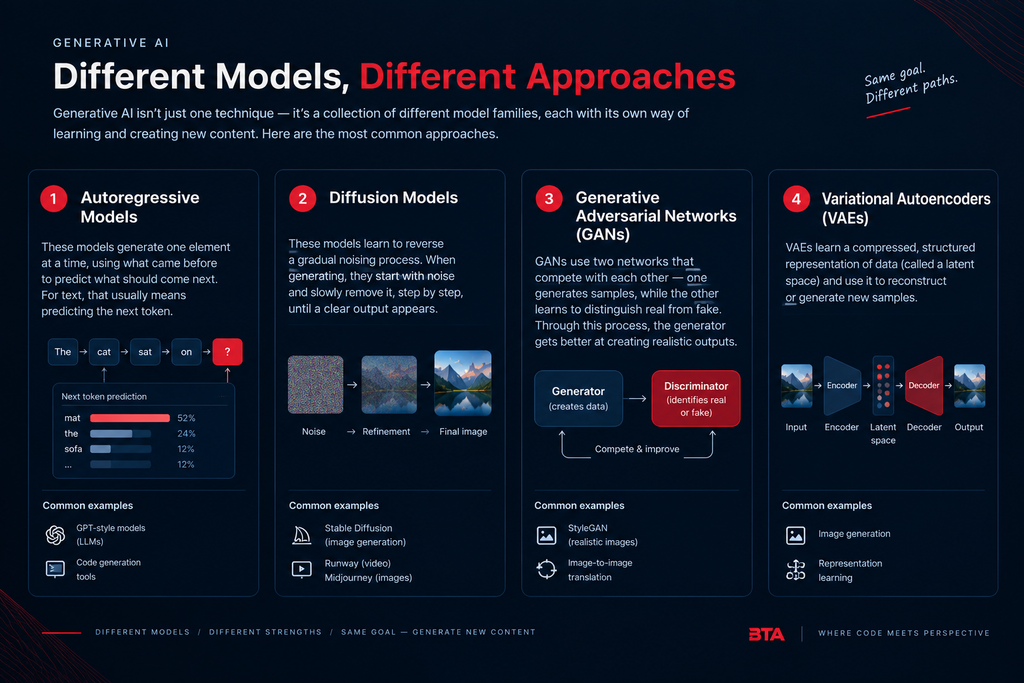
Autoregressive models
These models generate one element at a time, using what came before to predict what should come next. For text, that usually means predicting the next token. Many GPT-style language models work this way.
Diffusion models
These models learn to reverse a process that adds noise to training data. When generating an image, a diffusion model can start with noise and repeatedly refine it into a more structured result.
Generative Adversarial Networks (GANs)
GANs train two networks in competition. One generates samples, while the other learns to distinguish generated samples from real examples. This approach has been used for realistic image generation and image transformation.
Variational Autoencoders (VAEs)
VAEs learn a structured, compressed representation of data and use it to reconstruct or generate samples. They’re useful for understanding latent spaces and exploring variations in data.
One small technical note: these aren’t six completely separate boxes. Some terms describe a model architecture, while others describe a training or generation approach. Modern systems can combine multiple ideas.
The key takeaway is that Generative AI is an umbrella term. It describes what these systems do—generate content—not one single algorithm that every tool uses.
Does It Copy What It Has Seen?
This is a fair question. If a model learns from existing examples, does it simply copy and paste them?
Not necessarily. Models can learn patterns and produce combinations that weren’t present as exact examples in their training data. But we shouldn’t swing to the opposite extreme and assume every output is completely original, either. Models can sometimes memorise and reproduce parts of their training data.
So it’s more accurate to say that Generative AI creates outputs using patterns learned from data, with the possibility of both novel combinations and memorised material.
Can We Trust Everything It Generates?
Definitely not.
A response from Generative AI can sound polished and still contain a mistake. A generated image can look realistic without depicting a real event. Code can look convincing and still fail when you run it.
That’s why it’s important to check important claims, test code, and use reliable sources when accuracy matters. We’ve explored a related issue in Why Does AI Hallucinate?, including why an answer that sounds confident isn’t automatically correct.
This doesn’t make Generative AI useless. It simply means that generating an answer and verifying that answer are two different jobs.
Is It Useful for Students?
Generative AI can be useful for students—when you use it to support your thinking rather than replace it.
You can ask it to explain a difficult concept in simpler language, create practice questions, suggest project ideas, or help you understand an error in your code. But don’t stop at copying the response. Ask follow-up questions, check the explanation, and try to apply what you learned yourself.
That’s the approach I discuss in I Used AI to Learn AI — Is That Cheating?: getting an answer is easy, but understanding why that answer makes sense is the real learning.
For students who want to move from using tools to experimenting with models, Generative AI can also be a doorway into topics like neural networks, Transformers, and model deployment. You can explore those concepts gradually; there’s no need to learn everything in one day.
What Are Its Limitations?
Like any technology, Generative AI has trade-offs. Its output depends on the model, the input, the training process, and the task. It may produce inaccurate information, reflect biases in its data, or struggle with a request that needs context it doesn’t have.
Some tools also send prompts to remote services, so it’s worth checking their privacy policies before sharing personal, confidential, or sensitive information. And depending on the model, generating high-quality content can require substantial computing resources.
The practical rule is simple: use it as a tool, not as an unquestionable authority.
Final Thoughts
Generative AI is easier to understand once you stop treating it like magic. It learns patterns from data and uses those patterns to generate content—whether that’s a paragraph, an image, a sound, or a piece of code.
Different approaches make this possible in different ways, and each comes with its own strengths and limitations. You don’t have to master the mathematics immediately. Start with the basic idea, explore examples, and keep asking how the technology works behind the scenes.
Because the goal isn’t just to use AI. It’s to understand what you’re using—and know when to question it.
That’s where curiosity takes you beyond the algorithm.
Sources & Further Reading
Want to explore Generative AI beyond the basics? These resources can help you understand how it works, how models learn, and where to learn more.
- Google Cloud — Introduction to Generative AI
A beginner-friendly learning path covering Generative AI fundamentals, large language models, and responsible AI. - OpenAI — How ChatGPT and Our Foundation Models Are Developed
Learn how training data, model training, and pattern recognition contribute to the way AI systems generate responses. - OpenAI — Generative Models
Explore the underlying ideas behind generative models, including how they learn patterns from data to create new content. - Google Cloud — Generative AI Beginner’s Guide
Understand the core technologies behind Generative AI and how they support text, image, audio, and other content-generation applications.
These resources were consulted as further reading for this beginner-friendly introduction. The explanations in this article have been simplified to make the concepts easier to understand.